Verdict Expected in The Hague Over Former Kosovo President’s Alleged Witness Tampering
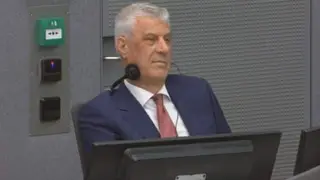
The second trial of former Kosovo President Hashim Thaci, accused of obstructing justice by influencing witnesses in his prior war crimes case, is nearing conclusion. Prosecutors sought six years in prison for Thaci and shorter terms for four co-defendants, citing efforts to manipulate testimony from two former KLA fighters. Thaci was previously sentenced to 25 years for war crimes in 2026.
Former Kosovo President Hashim Thaci faces a verdict on Tuesday in The Hague over allegations of obstructing justice during his 2026 war crimes trial, marking the conclusion of a second legal proceeding against him. Prosecutors accused Thaci and four co-defendants—Hajredin Kuci, Fadil Fazliu, Isni Kilaj, and Bashkim Smakaj—of attempting to influence two former Kosovo Liberation Army (KLA) fighters, Bislim Zyrapi and Rrustem Mustafa, who testified in his earlier case. The prosecution claimed Thaci directed his associates to guide the witnesses’ testimony, seeking six years in prison for him and shorter sentences for the others. Both Zyrapi and Mustafa had provided testimony in 2023 and 2024 respectively, stating that KLA zone commanders made key decisions and that the General Staff lacked full control over lower-level units—testimony that aligned with Thaci’s defense. On September 16, 2026, Thaci was sentenced to 25 years in prison for war crimes including murder, torture, and arbitrary detention, while his co-defendants received sentences ranging from 13 to 25 years. The verdict sparked protests across Kosovo and among the Albanian diaspora in Europe, prompting Kosovo’s parliament to vote on October 6 to amend laws restricting the Specialist Chambers’ authority. However, the EU and UK have cautioned against unilateral changes, citing the court’s foundation in international agreements. The appeal process remains pending, and the outcome of this second trial could further challenge the legitimacy of the Specialist Chambers.
The case underscores deep tensions between national sovereignty and international justice, particularly in post-conflict societies where former fighters are revered as heroes. Thaci’s prosecution and the ongoing legal challenges may affect public trust in judicial institutions across the Western Balkans, especially if perceived as politically motivated or inconsistent with local sentiment. The Specialist Chambers, established to ensure impartiality due to doubts about Kosovo’s domestic judiciary, now faces potential erosion of its authority—a development that could undermine similar international tribunals. Comparable to the Slobodan Milošević trial at the ICTY, this case may set a precedent for how wartime leaders are held accountable in regions with strong nationalist narratives. The outcome of Thaci’s appeal and the fate of the proposed legal changes will be critical indicators of whether Kosovo can balance domestic political pressures with its commitments to international law. What remains uncertain is whether the EU and international community will enforce compliance or allow further legislative maneuvering, which could influence future cooperation on justice reform and EU integration efforts.