Rare White Dwarf–Sun-Like Binary System Detected as Long-Period Radio Transient
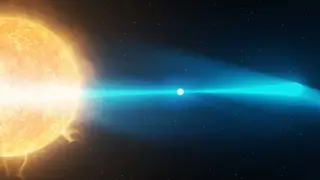
Astronomers have identified a long-period radio transient (LPT) with a white dwarf paired with a Sun-like G-type main sequence star, marking the first confirmed case of such a system among known LPTs. The discovery, published in Nature Astronomy, suggests that WDMS binaries could be common progenitors for Type Ia supernovae. The source emits radio pulses every few minutes, though the exact mechanism remains under investigation.
In November 2026, astronomers led by Dr. Sam McSweeney of Curtin University’s ICRAR node announced the discovery of GPM J071507−114153, a rare long-period radio transient (LPT) with a white dwarf paired with a Sun-like G-type main sequence star—marking the first confirmed case among known LPTs. Detected via the Murchison Widefield Array (MWA) in Australia and followed up with the MeerKAT telescope in South Africa, the system emits coherent radio pulses every 7.9 minutes, modulated by a longer 1.3-day orbital cycle. Optical spectroscopy from the Keck Telescopes on Mauna Kea confirmed the companion star’s spectral match to a G-type star, distinguishing it from previously observed LPTs dominated by white dwarf–red dwarf (M-dwarf) binaries. The MWA recorded 214 pulses, while MeerKAT detected 33, with 26 co-observed—providing high-precision localization. This system’s unique configuration challenges prior assumptions that only low-mass red dwarfs could sustain such radio emissions in WDMS binaries.
The discovery builds on a growing body of research into LPTs, which remain poorly understood despite their periodic nature. While some theories have invoked magnetars or exotic objects like strange dwarf pulsars, this finding supports the hypothesis that coherent radio emission in LPTs arises from interactions between white dwarfs and their companions. The clarity of the pulses allowed researchers to observe the white dwarf’s motion in orbit, suggesting the emission originates near or within the white dwarf itself. Notably, the team also detected stellar flares from the Sun-like star as it passed in front of the white dwarf, and observed the white dwarf moving behind a magnetic prominence—indicating complex magnetic interactions. The exact mechanism generating the radio pulses remains unresolved, though the presence of a G-type companion suggests such systems may be more common than previously thought. Future observations will focus on understanding how stellar companions influence emission processes and whether such binaries are frequent progenitors for Type Ia supernovae.
This discovery could reshape how astronomers classify and study transient radio sources, potentially expanding the known population of LPTs beyond red dwarf systems. If G-type WDMS binaries are common, it may imply a broader range of stellar environments capable of producing coherent radio emission—challenging current models of magnetic activity in compact binaries. The findings may influence future observational strategies, encouraging more targeted surveys using instruments like MeerKAT and the upcoming Square Kilometre Array (SKA), which could detect similar systems across the sky. Institutions involved, such as Curtin University and the Keck Observatory, may see increased funding or collaboration opportunities in time-domain astronomy. Societally, this reinforces public interest in space science and deepens understanding of stellar evolution, particularly the pathways leading to Type Ia supernovae—key tools for measuring cosmic distances. While not directly impacting technology or markets, such discoveries contribute to foundational knowledge that underpins astrophysics education and inspires future scientists. A comparable precedent is the 2013 discovery of fast radio bursts (FRBs), which initially baffled astronomers but eventually led to new insights into neutron star behavior and intergalactic plasma. As with FRBs, LPTs may eventually reveal hidden populations of compact objects. What to watch for next includes confirmation of additional G-type LPTs, refined models of magnetic interaction in binaries, and whether these systems can be linked to supernova progenitors—could this become a new standard pathway in stellar death studies?