Betelgeuse May Engulf Companion Star, Triggering a Bright Eruption in Millennia
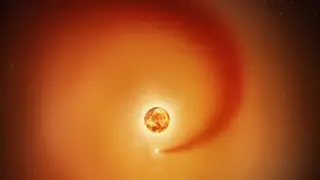
A new study suggests that Betelgeuse, the red supergiant star in Orion, may eventually swallow its recently discovered companion star in a few thousand years, causing a brilliant eruption visible from Earth. This event would temporarily outshine Venus in the night sky, preceding Betelgeuse’s eventual supernova. The discovery of the companion star, dubbed 'Betel-buddy,' adds complexity to the star’s final evolutionary stages.
Betelgeuse, the red supergiant star in Orion’s shoulder, may engulf its recently discovered companion—dubbed “Betel-buddy”—within the next 10,000 years, triggering a luminous red nova that could briefly outshine Venus in Earth’s night sky. This predicted event, modeled by Naunet Leonhardes-Barboza and her team at the University of California, Santa Cruz, hinges on simulations of three possible companion masses (0.7 to 2 solar masses), all of which predict a bright eruption lasting only a few days. The phenomenon, termed a “Great Brightening,” would follow Betelgeuse’s 2019 “Great Dimming,” when dust from ejected material temporarily obscured the star. The discovery of the companion, confirmed through recent observations, adds complexity to the star’s final evolution, suggesting a merger rather than a solitary supernova. The study, currently a preprint, leverages data from NASA’s Hubble Space Telescope and other observatories, with researchers emphasizing the rarity of observing a pre-merger system in real time.
The background includes decades of astronomical interest in Betelgeuse, from ancient stargazers noting its color shift to modern efforts tracking its dimming. The companion’s existence, confirmed in summer 2026, emerged from analyses of stellar motion anomalies and circumstellar dust patterns. Scientists like Jared Goldberg of the Flatiron Institute, though not involved in the study, highlight its broader implications: such luminous red novae could serve as detectable signatures of stellar mergers in distant galaxies, guiding future telescope searches. The unresolved question is the exact mass and orbit of Betel-buddy, which would determine the eruption’s timing and brightness. The event remains speculative, with no precise date or confirmation of the companion’s presence beyond current models.
The story may inspire public fascination with stellar evolution, much like Tycho Brahe’s 1572 supernova captivated 16th-century Europe. Future generations could witness a rare, visible astronomical event that bridges science and wonder, potentially boosting interest in astronomy education and amateur stargazing. Institutions like planetariums and science museums may develop exhibits around the predicted “Great Brightening,” while space agencies could use the event as a teaching tool for public engagement. The broader impact lies in refining observational strategies: if luminous red novae are reliable indicators of stellar mergers, astronomers may better identify such events in distant galaxies, improving models of stellar death. Comparable to the 1987 supernova in the Large Magellanic Cloud, which galvanized global observation efforts, this event could catalyze coordinated international monitoring. What to watch for next is whether follow-up observations confirm the companion’s orbit and mass, and whether other red supergiants exhibit similar pre-supernova brightenings—could this be a common, previously overlooked phase in stellar evolution?