Type Ia Supernova SN 2026ahvu Detected Early in Distant Galaxy NGC 1433
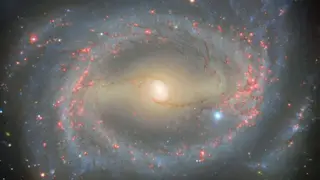
A Type Ia supernova named SN 2026ahvu was discovered on November 2nd, 2026, in the spiral galaxy NGC 1433, located about 50 million light years from Earth. Detected early by the ATLAS system, it is a result of a white dwarf accreting mass from a companion star until reaching the Chandrasekhar limit. Astronomers are now conducting detailed follow-up observations to study its evolution as a standard candle for cosmological measurements.
On November 2, 2026, the ATLAS system detected a new transient event in the spiral galaxy NGC 1433, located approximately 50 million light years from Earth. The supernova, designated SN 2026ahvu, was identified as a Type Ia supernova—originating from a white dwarf that reached the Chandrasekhar limit of about 1.44 solar masses by accreting material from a companion star or merging with another white dwarf. Early detection by ATLAS, which operates four 0.5-meter telescopes across Hawaii, Chile, South Africa, and Tenerife, allowed astronomers to begin monitoring the event just days after its onset. At discovery, SN 2026ahvu had an apparent magnitude of 17, brightening to 13.5 within a few days, indicating rapid luminosity rise typical of Type Ia events. The transient was reported via AstroNotes on the Transient Name Server (TNS), a registry managed by the International Astronomical Union, with follow-up observations coordinated through facilities like the Dark Energy Camera on the Víctor M. Blanco 4-meter Telescope and the Gemini South Telescope in Chile.
The significance of SN 2026ahvu lies in its proximity and early detection, enabling detailed study of its evolution from initial explosion through peak brightness and into the nebular phase. Type Ia supernovae are critical as standard candles for measuring cosmic distances due to their consistent peak luminosity, which relies on the radioactive decay of nickel-56 and later cobalt-56. Observations over the next few months will allow scientists to refine models of explosion mechanisms and test whether variations in progenitor systems affect brightness uniformity. The data may improve calibration of the cosmic distance ladder, with implications for measuring dark energy’s influence on the universe’s expansion. What remains unresolved is whether SN 2026ahvu’s progenitor was a single-degenerate (accreting) or double-degenerate (merging white dwarfs) system, and how its light curve compares to other well-studied events.
The early detection of SN 2026ahvu could enhance cosmological precision by providing a high-quality data point for calibrating Type Ia supernovae as standard candles. If its light curve and spectral evolution align closely with theoretical models, it may help reduce systematic errors in distance measurements used to study dark energy and the universe’s expansion rate. This has broader implications for astrophysics institutions relying on such data, including space agencies planning future missions like the Nancy Grace Roman Space Telescope, which aims to map cosmic structure using supernovae. The public may also benefit indirectly through improved models of stellar evolution and galactic dynamics, though direct societal impact remains minimal. A comparable precedent is SN 1998aq, one of the first Type Ia supernovae observed early enough to refine light curve models, which helped validate their use in cosmology. SN 2026ahvu may play a similar role today, especially given modern robotic survey capabilities like ATLAS and DECam that enable rapid response. However, unlike past events, this one benefits from global coordination through the TNS and real-time data sharing, accelerating scientific progress. What to watch for is whether discrepancies in SN 2026ahvu’s behavior—such as unusual brightness or spectral features—challenge current assumptions about progenitor systems, potentially reshaping how astronomers interpret supernova data across the cosmos.