Simons Observatory Begins High-Resolution Survey of Cosmic Microwave Background to Test Big Bang Theory
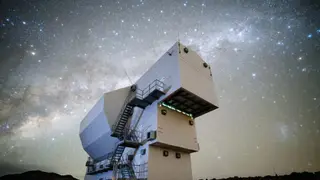
The Simons Observatory in the Atacama Desert has commenced its mission to map the Cosmic Microwave Background (CMB) with unprecedented detail using a unique combination of four telescopes, including a 6-meter Large Aperture Telescope and three smaller ones. Its primary goal is to detect primordial gravitational waves, which would provide strong evidence for cosmic inflation and confirm key aspects of the Big Bang model. The observatory's enhanced resolution, an order of magnitude greater than the Planck satellite, positions it to deliver critical data on the early Universe.
In August 2026, the Simons Observatory (SO) in Chile’s Atacama Desert began its high-resolution survey of the Cosmic Microwave Background (CMB), marking a pivotal moment in observational cosmology. The observatory employs a unique array of four telescopes: one 6-meter Large Aperture Telescope (LAT) and three smaller 0.5-meter Small Aperture Telescopes (SATs), collectively housing nearly 98,000 microwave detectors—16 times more than the Atacama Cosmology Telescope. This configuration enables an order-of-magnitude improvement in resolution over the Planck satellite, the previous benchmark in CMB mapping. The primary scientific goal is to detect B-mode polarization in the CMB, a signature that could confirm the existence of primordial gravitational waves generated during cosmic inflation, a key prediction of the Big Bang theory. The SO’s mission follows earlier efforts by the South Pole Telescope (SPT), which first detected B-mode signals in 2014, but whose results were later questioned due to contamination from gravitational lensing. The SO aims to disentangle these effects through superior sensitivity and multi-telescope coordination. Co-Director Suzanne Staggs of Princeton University has expressed optimism about the data flow and the potential for groundbreaking discoveries. The observatory’s two-year calibration phase concluded in 2026, and initial data from just a few months of operation already demonstrate its enhanced capabilities. However, definitive confirmation of inflationary gravitational waves remains years away, pending long-term data collection and analysis.
The Simons Observatory’s work could profoundly influence our understanding of the Universe’s origins, potentially validating or refining the Big Bang and inflation models that underpin modern cosmology. If successful, the detection of primordial B-modes would provide the strongest empirical support yet for cosmic inflation, a theory that has long been inferred but never directly observed. This could reshape theoretical physics, influence funding priorities for large-scale experiments, and inspire new generations of researchers. The broader scientific community, including institutions like Princeton University, the Simons Foundation, and international partners, stands to gain from the data’s open-access release, which may fuel decades of follow-up research. Comparable in societal impact to the discovery of the Higgs boson or the first detection of gravitational waves, SO’s findings could become foundational in physics education and public science literacy. However, the outcome remains uncertain—gravitational lensing remains a formidable contaminant, and no definitive signal has yet been confirmed. The next few years will be critical: if the SO detects a clean B-mode signal, it may trigger a paradigm shift; if not, it could prompt reevaluation of inflationary models. The scientific community will be watching closely, with implications extending beyond academia into technology, space policy, and public engagement with science.