South Pole Telescope Detects New B-mode Polarization in Cosmic Microwave Background
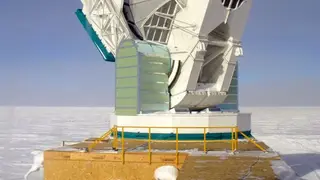
The South Pole Telescope, located at Amundsen–Scott South Pole Station, has detected new B-mode polarization patterns in the Cosmic Microwave Background, providing evidence of gravitational lensing by intervening matter such as galaxy clusters. This discovery confirms long-predicted features of the CMB and offers insights into the large-scale structure of the universe. The telescope operates in a radio-quiet zone with minimal atmospheric interference, enabling high-precision measurements of CMB anisotropies.
In November 2026, the South Pole Telescope (SPT), located at Amundsen–Scott South Pole Station in Antarctica, detected new B-mode polarization patterns in the Cosmic Microwave Background (CMB), confirming long-predicted effects of gravitational lensing by large-scale structures such as galaxy clusters. The 10-meter radio telescope operates in a radio-quiet zone with minimal atmospheric interference, enabling high-precision measurements of CMB anisotropies. This detection builds on earlier work by the Wilkinson Microwave Anisotropy Probe (WMAP) and the Planck satellite, which mapped temperature fluctuations in the CMB from space. The SPT’s recent findings mark a significant step in validating theoretical models of how matter in the universe distorts the CMB’s polarization. The discovery was led by John Carlstrom of the University of Chicago, who previously spearheaded the first detection of CMB polarization in 2002. The SPT’s success is part of a broader effort involving institutions like Caltech and Argonne National Laboratory, where researchers like Kimmy Wu and Lindsey Bleem are pursuing deeper insights into quantum gravity and cosmic inflation. While this B-mode signal stems from gravitational lensing—not primordial gravitational waves—its confirmation strengthens confidence in observational techniques. The next major goal remains detecting primordial B-modes, which would provide direct evidence of inflation and quantum gravity. This requires even more sensitive instruments like the BICEP array, currently in its fifth iteration, which has been operational since 2006. Whether such signals will be found remains uncertain, and current data has not yet ruled out or confirmed them.
The detection of gravitational lensing-induced B-mode polarization could influence how cosmology is taught and funded, reinforcing public and institutional trust in large-scale scientific infrastructure. Institutions like the National Science Foundation and NASA may see renewed interest in Antarctic and space-based observatories, potentially shaping future research budgets. The broader impact may extend to public engagement with science, as discoveries from extreme environments like the South Pole capture imaginations and highlight the value of international scientific cooperation. A comparable precedent is the 2014 BICEP2 false alarm, which generated widespread media attention and later prompted a more rigorous peer-review culture in cosmology. That episode demonstrated how high-stakes findings can affect scientific credibility and public perception. The current SPT results, while not claiming primordial signals, may help recalibrate expectations and improve the transparency of future claims. If BICEP or other projects eventually detect primordial B-modes, it could trigger a paradigm shift in theoretical physics, potentially influencing education, technology development in detector engineering, and even philosophical views on the universe’s origins. What to watch for next is not just confirmation of inflation, but how the scientific community manages the communication of incremental progress versus breakthroughs—especially in an era of heightened public scrutiny.