Indian EV Charging Franchises Require High Utilisation for Profitability Despite Low Entry Costs
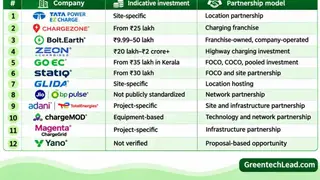
Franchise opportunities in India’s EV charging sector, offered by companies like Tata Power EZ Charge and Bolt.Earth, require investments starting at ₹9.99 lakh. Profitability depends heavily on charger utilisation, electricity tariffs, and operational costs rather than initial investment size. The Ministry of Heavy Industries reported 52,718 public charging stations in India as of July 2026.
As of July 2026, India had 52,718 public EV charging stations, including 16,561 fast chargers, according to the Ministry of Heavy Industries, signaling rapid infrastructure growth despite uneven deployment. Franchise opportunities in this sector, offered by companies like Tata Power EZ Charge, Bolt.Earth, and Jio-bp pulse, are attracting investors with entry costs as low as ₹9.99 lakh, particularly through models where companies manage operations while franchisees finance infrastructure. However, profitability is not guaranteed by low upfront investment; instead, it hinges on charger utilisation rates, electricity tariffs, maintenance costs, and revenue-sharing terms. For instance, a State Bank of India assessment suggests that 10–15% utilisation may be needed to cover operating expenses, though actual break-even levels vary by location and grid availability. Companies such as ChargeZone and ZEON Charging offer higher investment packages—up to ₹2 crore—depending on charger capacity and site location, with critical factors including transformer upgrades, land development, and grid connectivity. Despite the variety of models, investors must verify what is included in quoted packages, as hidden costs like electricity deposits and civil works can significantly affect returns. The involvement of major players like Adani TotalEnergies and GLIDA underscores the sector’s expansion into highways, commercial properties, and fleet operations. What remains unresolved is whether these franchises can achieve sustainable returns given the uncertainty around customer demand, fluctuating electricity prices, and the lack of standardized performance metrics across operators.
The rise of low-cost EV charging franchises in India could accelerate the adoption of electric mobility by expanding infrastructure access, particularly in urban and semi-urban centers. However, the high reliance on utilisation rates—potentially requiring 10–15% usage just to break even—means that many franchisees may struggle in low-traffic areas, potentially leading to underutilized assets and financial losses. This could deter smaller investors or create a market imbalance favoring high-traffic zones like highways and commercial hubs. The involvement of large energy firms like Tata Power, Jio-bp, and Adani TotalEnergies may stabilize the sector, but their operational control models could limit franchisee autonomy and transparency. A comparable case is the early rollout of public Wi-Fi networks in India, where initial enthusiasm was followed by underuse due to poor planning and lack of demand validation. Here, the risk is similar: infrastructure may be deployed before market readiness. What may unfold is a consolidation phase where only the most strategically located or well-managed stations survive. Investors and policymakers should watch for regulatory clarity on electricity pricing, standardization of performance reporting, and the emergence of third-party verification for utilisation data, which could shape long-term viability.