India’s Commercial Rooftop Solar Market Grows with Financing and Installation Innovation
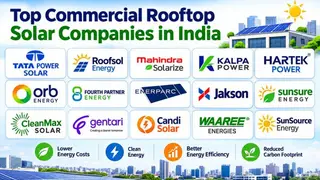
In 2027, India’s commercial and industrial rooftop solar sector is expanding rapidly, with companies like Tata Power Solar, Roofsol Energy, and CleanMax leading in installations across factories, malls, and hospitals. Tata Power Solar launched SunSmart Flexi EMI financing to align repayments with solar generation, while Roofsol Energy focuses on customized rooftop engineering. By March 2026, India had reached 25.73 GW of rooftop capacity, with 8.71 GW added in the prior fiscal year through government and private initiatives.
By March 2026, India had achieved 25.73 GW of rooftop solar capacity, with 8.71 GW added in the preceding fiscal year—6.72 GW under the PM Surya Ghar scheme and about 2 GW from commercial and industrial (C&I) installations. This growth reflects a strategic shift toward decentralized renewable energy, driven by government incentives and private sector innovation. Key players like Tata Power Solar, Roofsol Energy, Mahindra Solarize, CleanMax, and Fourth Partner Energy are leading the charge, offering tailored engineering, installation, and financing solutions. Tata Power Solar’s SunSmart Flexi EMI, launched in March 2026 in partnership with Tata Capital, aligns loan repayments with solar generation cycles, reducing financial strain for customers. Similarly, Orb Energy has disbursed over ₹340 crore in financing to more than 360 SMEs, addressing the upfront cost barrier that historically hindered adoption. These developments are rooted in earlier policy momentum, including the National Solar Mission and state-level mandates, which laid the groundwork for a robust C&I solar market. The Ministry of New and Renewable Energy reports that broader C&I renewable procurement—including captive projects—added around 15 GW through various mechanisms by 2026. Companies are competing not just on price but on engineering precision, remote monitoring, maintenance quality, and flexible ownership models. What remains uncertain is the scalability of these financing innovations beyond large enterprises and whether regulatory support will sustain momentum post-PM Surya Ghar phase.
The expansion of India’s commercial rooftop solar market could significantly reduce industrial electricity costs and carbon emissions, particularly in energy-intensive sectors like manufacturing and logistics. As businesses increasingly prioritize sustainability and cost efficiency, the rise of third-party financing models—such as those offered by Orb Energy and Enerparc—may democratize access to solar power, enabling SMEs to adopt clean energy without large capital outlays. This shift could reshape India’s energy landscape, reducing grid dependency and supporting national climate goals. A comparable precedent is the rapid adoption of rooftop solar in Germany during the early 2010s, where feed-in tariffs and accessible financing drove widespread deployment. However, India’s scale and diversity present unique challenges, including uneven infrastructure and regional disparities in policy implementation. The success of current initiatives may depend on continued government incentives, grid modernization, and private investment in storage integration. What to watch for next is whether these commercial projects will catalyze broader corporate decarbonization strategies or remain isolated efficiency measures—especially as energy prices fluctuate and climate regulations evolve.