Bosnia’s Constitutional Court Strikes Down Republika Srpska Law Banning Symbols of 1990s Bosniak-led Army
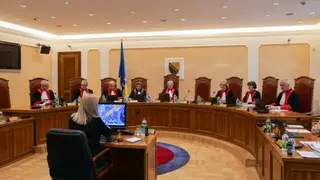
Bosnia and Herzegovina’s Constitutional Court has declared unconstitutional a Republika Srpska law that imposed prison sentences for displaying symbols of the 1990s Bosniak-led Army of Bosnia and Herzegovina. The court ruled that the entity’s National Assembly lacked authority to override national laws governing military symbols and insignia. The law, which also criminalized displays of Independent State of Croatia symbols, was challenged for violating constitutional provisions on state-level jurisdiction.
On November 20, 2026, Bosnia and Herzegovina’s Constitutional Court invalidated a law passed by Republika Srpska’s National Assembly in July of the same year, which criminalized the public display, production, or promotion of symbols associated with the 1990s Bosniak-led Army of Bosnia and Herzegovina. The law, which imposed prison sentences of up to three years—extending to five years if acts incited unrest—also banned symbols of the Independent State of Croatia, a fascist regime from World War II. The court ruled that Republika Srpska’s entity-level legislature lacked the constitutional authority to override national laws governing military insignia and symbols, which are regulated at the state level. The decision specifically cited inconsistencies with existing national legislation on the use of official symbols by the Armed Forces of Bosnia and Herzegovina. The law had been introduced amid ongoing tensions over historical memory and national identity in the post-war federation, particularly in Republika Srpska, where the legacy of the 1992–1995 war remains deeply contested. The Constitutional Court’s ruling reaffirms the supremacy of state-level legal authority over entity-level legislation in matters of national military symbolism.
The Army of Bosnia and Herzegovina, established during the war, was a multi-ethnic force, but its Bosniak-led command and operations have become symbolic of Bosniak national identity. Republika Srpska’s ban reflects broader efforts by Serb political leaders to suppress symbols perceived as representing past military aggression by Bosniak forces. The court’s decision, however, may not fully resolve underlying tensions, as the entity’s political leadership may challenge the ruling through other legislative or political channels. The outcome could influence future debates on historical memory, national unity, and the balance of power between the state and entity levels in Bosnia and Herzegovina. What remains unresolved is whether Republika Srpska will comply with the ruling or attempt to circumvent it through alternative legal mechanisms. The role of civil society and international observers in monitoring implementation will be crucial.
The Constitutional Court’s ruling could significantly affect public discourse on historical memory and national identity in Bosnia and Herzegovina, particularly in Republika Srpska, where such laws have long been used to reinforce ethnic divisions. By striking down the ban, the court may empower Bosniak communities to reclaim symbols of resistance and statehood, potentially fostering greater inclusion. However, this could also provoke backlash among Serb political elites who view the Army of Bosnia and Herzegovina as a symbol of past victimization. The decision may embolden civil society groups advocating for reconciliation, but it could also deepen polarization if implemented unevenly or met with defiance. A comparable precedent is the 2005 Bosnian Constitutional Court ruling that invalidated a similar law banning the display of the wartime Serb flag, which similarly highlighted the tension between entity autonomy and state-level constitutional authority. The long-term impact may depend on whether the ruling is enforced uniformly across all entities. What to watch for next is whether Republika Srpska’s leadership appeals the decision or seeks to reframe the law through new legislation, potentially testing the resilience of Bosnia’s fragile constitutional framework.