Alternative Universe Model Passes Major Cosmological Tests Without Dark Matter or Dark Energy
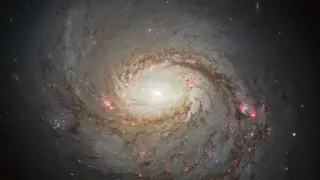
The Covarying Coupling Constants plus Tired Light (CCC+TL) model, proposed by researchers at the University of Ottawa, has successfully passed key tests including predictions of early element abundance and cosmic chronometer data. The model suggests the universe is 26.7 billion years old and eliminates the need for dark matter and dark energy. This challenges the standard Lambda Cold Dark Matter (ΛCDM) model, especially in light of JWST observations of mature early galaxies.
In November 2026, researchers at the University of Ottawa, led by Adjunct Professor Rajendra Gupta and postdoctoral researcher Dr. Nikolaos Samaras, published findings demonstrating that the Covarying Coupling Constants plus Tired Light (CCC+TL) model successfully passes key cosmological tests without invoking dark matter or dark energy. The model, tested against predictions of light element abundance from the Big Bang and cosmic chronometer data, suggests the universe is approximately 26.7 billion years old—significantly older than the standard ΛCDM model’s 13.8 billion years. This revised timeline helps explain the presence of mature galaxies observed by the James Webb Space Telescope (JWST) in the early universe, which have long challenged the standard model’s timeline for galaxy formation. The CCC+TL model modifies Einstein’s field equations and the Friedmann–Lemaître equations, proposing that evolving fundamental constants—rather than unseen matter or energy—account for observed gravitational effects. The team validated the model using data from 175 galaxies in the SPARC database, reproducing rotational curves without dark matter, and found consistency with the Bullet Cluster’s gravitational lensing patterns. They also applied it to supernova time dilation data, with results pending peer review. The model’s success in aligning with multiple independent observations marks a significant departure from the ΛCDM framework, which has struggled to explain early galaxy maturity and lacks direct detection of dark matter or dark energy after decades of searching.
If validated, the CCC+TL model could reshape cosmology’s foundational assumptions, challenging the dominance of the ΛCDM paradigm that has guided research for decades. The implications extend beyond academia: funding agencies, space observatories like JWST, and future missions may need to reevaluate their observational priorities. Institutions relying on ΛCDM for theoretical frameworks—such as those modeling galaxy evolution or cosmic reionization—may face a paradigm shift. A comparable precedent is the shift from geocentrism to heliocentrism, where entrenched models were overturned by new evidence. While the CCC+TL model is still in early validation stages, its ability to explain early galaxy maturity without dark matter could influence how astronomers interpret deep-field surveys. The upcoming GO 3293 GLIMPSE program and other JWST initiatives may provide critical tests. Should the model withstand further scrutiny, it could inspire new physics beyond general relativity, though its complexity and non-standard nature may slow adoption. The broader scientific community may respond with cautious interest, as such a shift could redefine how we understand the universe’s age, structure, and evolution.