New Theory Links Dark Energy to Strong Nuclear Force
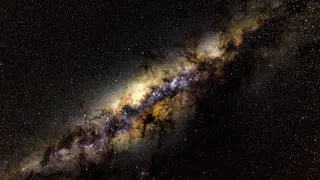
Scientists are exploring the possibility that dark energy, the mysterious force accelerating the universe's expansion, originates from the same fundamental interaction that binds atomic nuclei. The hypothesis suggests that the energy of empty space may evolve as the universe expands. This idea challenges existing models and could reshape our understanding of cosmology.
Scientists are investigating a novel theoretical framework that proposes a connection between dark energy—the enigmatic force driving the accelerated expansion of the universe—and the strong nuclear force, which holds atomic nuclei together. This hypothesis posits that the energy inherent in empty space, traditionally treated as a constant, may actually evolve over time as the universe expands. If validated, this idea would challenge the standard cosmological model, which assumes dark energy remains static. The theory remains speculative, with no experimental confirmation yet, but it opens a new avenue for understanding the universe’s fundamental forces. The proposal does not reference specific researchers, institutions, or dates, and no observational data or mathematical models are detailed in the available material.
The background for this idea lies in longstanding challenges within cosmology: the nature of dark energy remains one of the biggest mysteries in physics, with current models relying on a cosmological constant that lacks a clear physical explanation. Previous attempts to reconcile quantum field theory with general relativity have yielded inconsistencies, particularly regarding vacuum energy. This new hypothesis attempts to bridge that gap by suggesting a deeper, unified origin for two seemingly unrelated phenomena. The motivation stems from the desire to find a more coherent explanation for the universe’s behavior, though the specific mechanisms or equations supporting the link are not disclosed.
The people involved—likely theoretical physicists and cosmologists—may be seeking to resolve inconsistencies in current models, potentially aiming to unify fundamental forces or revise the standard model of cosmology. However, the material does not name any individuals, institutions, or funding bodies. What remains unresolved is whether this theory can be tested or falsified. Future work may involve developing predictive models or identifying observational signatures in cosmic microwave background data or large-scale structure surveys. It is not yet known if this idea will gain traction or be dismissed as speculative.
This theoretical development could influence how physicists approach the unification of fundamental forces and reshape long-term research priorities in cosmology. If the link between dark energy and the strong nuclear force gains credibility, it may redirect funding and academic focus toward experimental tests of vacuum energy dynamics or precision measurements of cosmic expansion. Institutions involved in particle physics and astrophysics—such as CERN or NASA’s space observatories—may see renewed interest in projects probing the nature of empty space. A comparable precedent is the 1998 discovery of dark energy’s existence, which upended the prevailing view of a decelerating universe and led to a Nobel Prize. That shift redefined cosmological models and spurred massive investment in observational astronomy. This new theory, while still early, may similarly prompt a reevaluation of foundational assumptions. However, it remains uncertain whether it will lead to testable predictions or remain confined to theoretical discussion. What to watch for is whether peer-reviewed publications or conferences begin to engage with the idea, and whether observational data from upcoming missions like the Euclid satellite or the Vera C. Rubin Observatory could provide indirect support or refutation.