The Pleiades Star Cluster: A Globally Revered Celestial Wonder
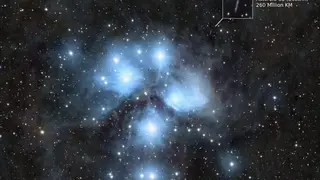
The Pleiades, also known as the Seven Sisters or Messier 45, is a prominent star cluster visible from nearly every location on Earth, appearing as a faint, clustered dipper of stars. Ancient cultures including the Greeks and Polynesians have woven myths around the cluster, with Greek legends describing the sisters as daughters of Atlas and Pleione, or as companions of Artemis. The cluster remains a popular subject for stargazers and astrophotographers, as seen in a recent image from Egypt capturing the cluster alongside asteroid 83 Beatrix.
In November 2026, stargazer Mohammed Abdallah captured a striking image of the Pleiades star cluster from Suez, Egypt, during a nearly 20-hour observational session that included the rare passage of asteroid 83 Beatrix across the same field of view. This composite image, shared through EarthSky’s Community Photos, highlights the enduring appeal of the Pleiades—also known as Messier 45 or the Seven Sisters—as a celestial object accessible to amateur astronomers worldwide. The cluster, located approximately 440 light-years from Earth, is an open star cluster formed from a single molecular cloud about 100 million years ago, now containing over 3,000 stars. Its visibility from nearly every location on Earth, including polar regions and southernmost South America, underscores its global significance. The Pleiades’ prominence in ancient mythologies—from Greek tales of Atlas’s daughters to Polynesian legends of a shattered star—has persisted into modern times, influencing cultural practices such as the origins of Halloween, which coincided with the cluster’s midnight culmination in ancient Druid traditions. The cluster’s seasonal visibility in the Northern Hemisphere, particularly from November through April, aligns with its association with winter and has made it a staple in amateur astronomy and astrophotography.
The story is rooted in long-standing human fascination with the night sky, documented through centuries of myth, navigation, and scientific inquiry. EarthSky, a science communication platform, continues to bridge public interest with astronomical data by showcasing community-submitted images and educational content. The involvement of amateur astronomers like Abdallah, Andy Dungan, and Muhammad Alaa demonstrates how accessible space exploration has become with modern equipment such as the Dwarf 3 smart scope. While the scientific community has confirmed the cluster’s stellar origins and dynamics, the cultural narratives surrounding it remain active and evolving. What remains unresolved is the precise role of the Pleiades in contemporary cultural identity beyond astronomy, and whether such celestial storytelling will influence future space education or public engagement initiatives. The next phase may involve deeper integration of these stories into STEM outreach programs, particularly in regions where the cluster is culturally significant.
The Pleiades’ enduring presence in global mythology and modern astrophotography underscores how celestial phenomena can serve as cultural touchstones, connecting diverse communities across time and geography. This story may inspire renewed interest in amateur astronomy, particularly among younger generations and underrepresented groups in STEM, by linking scientific facts with accessible, emotionally resonant narratives. EarthSky’s role in curating community contributions suggests a growing model for public participation in science communication, where individual observations gain visibility and value. Comparable to the widespread public engagement during the 2017 total solar eclipse in the U.S., the Pleiades’ visibility and mythic legacy could catalyze similar waves of public curiosity, potentially boosting sales of telescopes, astronomy apps, and educational materials. Institutions like planetariums and science museums may leverage such stories to enhance visitor experiences. What to watch for is whether this cultural resonance translates into sustained funding for public science outreach or broader efforts to integrate indigenous astronomical knowledge into formal education. The story’s impact may be subtle but cumulative—shaping how people perceive the cosmos not just as distant science, but as a shared human heritage.