Fomalhaut Marks the Milky Way’s Southern Window to Intergalactic Space
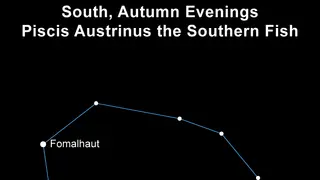
Looking toward the bright star Fomalhaut in the constellation Piscis Austrinus provides a view out of the plane of the Milky Way, offering a glimpse into intergalactic space. This region, known as the galaxy’s south window, lies about 90 degrees from the galactic equator, making it appear relatively empty of stars compared to the dense galactic plane. Observers in the Northern Hemisphere can use this direction to explore the vast, sparsely populated regions beyond our galaxy.
On November 19, 2026, EarthSky published a story highlighting Fomalhaut, the brightest star in the constellation Piscis Austrinus, as a key navigational marker for observing the Milky Way’s southern galactic pole. Located approximately 90 degrees from the galactic equator, this region offers a rare vantage point into intergalactic space, where the density of stars is significantly lower than in the galactic plane. The article emphasizes that observers in the Northern Hemisphere can use Fomalhaut as a guide to look “out the galaxy’s south window,” with the actual south galactic pole situated east of Fomalhaut in the faint constellation Sculptor. The piece references the Great Square of Pegasus as a celestial landmark to locate Fomalhaut, particularly visible in late November and early December at 7–8 p.m. local time. The story draws on established astronomical knowledge, such as the Milky Way’s disk-like structure, to explain why this direction appears relatively empty and thus ideal for viewing beyond the galaxy.
The background for this narrative lies in long-standing astronomical understanding of galactic structure, with the concept of galactic poles being well-documented since the 19th century. EarthSky, as a science communication platform, continues its tradition of making complex topics accessible through visual aids and seasonal sky guides. The article’s authors—Bruce McClure and EarthSky Voices—represent a collective effort to engage the public with observational astronomy, using Fomalhaut as a gateway to deeper cosmic inquiry. While no new discoveries are reported, the story serves to reframe a familiar star as a portal to intergalactic space, potentially inspiring amateur astronomers and educators. What remains unresolved is whether this narrative will influence future public outreach initiatives or be integrated into educational curricula beyond EarthSky’s existing content.
The story may encourage amateur astronomers and educators to use Fomalhaut as a teaching tool for understanding galactic structure and intergalactic space, particularly in Northern Hemisphere outreach programs. By framing a bright, easily identifiable star as a gateway to cosmic vastness, EarthSky could be fostering a broader public interest in deep-space observation and cosmology. This approach mirrors earlier efforts like the “Cosmic Calendar” by Carl Sagan, which used familiar timeframes to convey astronomical scale. The impact may be most pronounced in informal learning environments—stargazing clubs, school programs, and science festivals—where accessible metaphors help demystify complex concepts. However, the story’s influence on professional astronomy or space policy is likely minimal, as it does not report new data or propose new missions. What to watch for is whether similar metaphors—“galactic windows,” “cosmic doorways”—become standard in science communication, potentially shaping how future generations perceive their place in the universe.