Tucana the Toucan hosts the Small Magellanic Cloud and 47 Tucanae star cluster
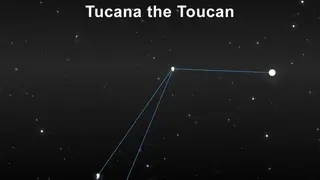
The constellation Tucana the Toucan, visible year-round from the Southern Hemisphere, contains the Small Magellanic Cloud—a dwarf galaxy orbiting the Milky Way—and the bright globular star cluster 47 Tucanae (NGC 104). Both objects are visible to the unaided eye and are located near the south celestial pole, making them prominent features in southern skies.
The constellation Tucana the Toucan, located near the south celestial pole, hosts two prominent deep-sky objects visible to the unaided eye: the Small Magellanic Cloud (SMC), a dwarf galaxy orbiting the Milky Way, and the globular cluster 47 Tucanae (NGC 104). The SMC lies approximately 197,000 light-years from Earth and is one of the closest galaxies to our own, visible as a faint, diffuse patch in dark southern skies. It is the smaller of two satellite galaxies of the Milky Way, the other being the Large Magellanic Cloud, both of which are being gravitationally drawn toward our galaxy and will eventually be absorbed. Meanwhile, 47 Tucanae, located 14,500 light-years away, is the second-brightest globular cluster in the night sky, shining at magnitude 4.0 and appearing as large as the full moon under ideal conditions. Though they appear close together in the sky, this is a line-of-sight alignment—47 Tucanae is much closer than the SMC. The constellation itself is not particularly bright, with its brightest star, Alpha Tucanae, at magnitude 2.87, and is best observed from the Southern Hemisphere.
The visibility of these objects from Earth’s southern skies has made them key targets for amateur astronomers and professional observatories alike. The European Southern Observatory’s VISTA telescope has captured detailed infrared images of the SMC, revealing structures obscured by dust in visible light. The Hubble Space Telescope has also studied 47 Tucanae, resolving millions of stars within it. These observations contribute to broader efforts to understand galaxy formation, stellar evolution, and the dynamics of galactic interactions. The story is rooted in long-standing astronomical observation, dating back to the Magellanic explorations of the 15th century, which gave the galaxies their names. Modern institutions like ESO, NASA, and the ESA continue to study these objects through advanced telescopes, driven by scientific curiosity and the goal of mapping the Milky Way’s cosmic neighborhood. What remains unresolved is the full timeline of the SMC’s interaction with the Milky Way and the precise origin of 47 Tucanae’s formation. Future missions may clarify whether the cluster originated within the Milky Way or was captured from a dwarf galaxy.
The visibility of the Small Magellanic Cloud and 47 Tucanae in the southern sky could inspire greater public engagement with astronomy, particularly in regions with dark skies such as Chile and southern Africa. These objects serve as accessible entry points for amateur stargazers, potentially increasing interest in citizen science projects and observational astronomy. Educational institutions may leverage their prominence to promote STEM outreach, especially in the Southern Hemisphere, where they are more easily visible. The story may also influence tourism, as dark-sky tourism grows in popularity—locations like the Atacama Desert, home to the ALMA observatory, could see increased visitor interest due to the visibility of these celestial landmarks. Historically, the Magellanic Clouds played a pivotal role in early galactic astronomy, challenging the notion that the Milky Way was the only significant galaxy. Their discovery helped shift scientific understanding from a geocentric to a more expansive cosmological model. Today, their study continues to inform models of galaxy evolution and dark matter distribution. The current focus on these objects may accelerate investment in infrared and multi-wavelength observatories, as seen with VISTA’s success. What could emerge next is a broader public awareness of the Milky Way’s dynamic environment, potentially influencing how space agencies frame their missions to study galactic interactions. The story may also encourage more inclusive astronomy education, ensuring that southern sky phenomena are not overlooked in global science curricula.