Ariane 64 to Deploy 36 Amazon Leo Satellites in Record-Setting Launch from French Guiana
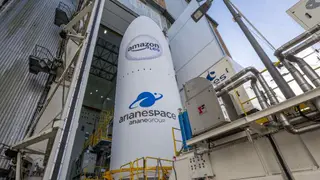
The Ariane 64 rocket, configured with four P160C solid rocket boosters, is set to launch 36 Amazon Leo satellites into low-Earth orbit from Europe's Spaceport in French Guiana on November 23, 2026. This mission marks the 10th flight of the Ariane 6 rocket and Arianespace’s fourth launch for Amazon Leo, enhancing global connectivity through expanded satellite coverage. The launch window spans from 6:09 to 6:38 am EST, with a live webcast available on Arianespace’s YouTube channel starting at 5:37 am EST.
On November 23, 2026, Arianespace will launch the Ariane 64 rocket from Europe’s Spaceport in Kourou, French Guiana, carrying 36 Amazon Leo satellites into low-Earth orbit. This mission marks the 10th flight of the Ariane 6 rocket and the fourth dedicated to Amazon’s Leo constellation, with a launch window from 6:09 to 6:38 am EST. The Ariane 64 configuration, featuring four P160C solid rocket boosters, is the most powerful variant of the rocket, standing 62 meters tall and capable of lifting up to 21.6 tonnes—double the payload capacity of its two-booster predecessor. The satellites, encapsulated in the fairing, were integrated onto the rocket following a successful launch readiness review, with final preparations completed by late November 2026. This launch follows a June 2026 mission that set a 13-year record for the heaviest payload launched by a European rocket. The previous Amazon Leo launch, on November 15, failed due to a "low booster performance" issue on the ULA Vulcan rocket, which failed to achieve sufficient thrust for proper satellite deployment. Amazon has contracted 24 launches across multiple providers, including SpaceX’s Falcon 9, Blue Origin’s New Glenn, and ULA’s Vulcan, reflecting a strategy to diversify launch providers and mitigate risk. The outcome of the Ariane 64 launch will be critical for maintaining the timeline of Amazon’s global broadband ambitions. What remains unresolved is whether the Ariane 64’s performance will match or exceed that of the June 2026 flight, and how the failure of the Vulcan mission may influence future launch contracts and reliability assessments.
This launch could significantly impact global internet access by advancing Amazon’s goal of delivering high-speed broadband to underserved regions through its Leo satellite constellation. If successful, it may reinforce confidence in Arianespace as a reliable European launch provider, especially after the recent Vulcan failure, which exposed vulnerabilities in U.S.-based launch systems despite their high-profile status. The broader satellite internet market, currently led by SpaceX’s Starlink, may see increased competition, potentially driving innovation and lowering costs for consumers. Arianespace’s success could also influence future government and commercial contracts, particularly as Europe seeks to reduce reliance on American launch providers. The failure of the November 15 Vulcan mission, attributed to inadequate fuel supply, highlights the fragility of complex launch systems and may prompt more rigorous pre-flight checks across the industry. Looking ahead, the performance of this Ariane 64 mission could shape Amazon’s launch strategy, possibly affecting future investments in New Glenn or Falcon 9. The outcome may also influence how space agencies and private firms assess risk when selecting launch vehicles, especially for large-scale constellations.