Trump’s Press Briefing Lapses into Incoherent Rambling Amid Foreign Trip
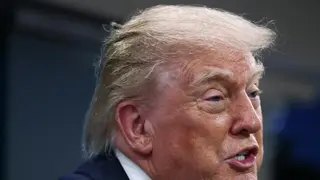
President Donald Trump delivered a disjointed and incoherent press briefing following a trip to China, veering from topics like his genetics and Nobel Prize aspirations to agricultural exports and Greenland. He made unsubstantiated claims about influencing global leaders and promoting U.S. data centers, while his aides appeared visibly uncomfortable. The briefing lacked focus on the $17 billion Indo-Pacific investment plan and a new U.S.-Russia-China peace declaration.
On November 20, 2026, President Donald Trump delivered a press briefing following a trip to China that quickly devolved into a disjointed and incoherent monologue, failing to address key foreign policy initiatives such as the $17 billion Indo-Pacific investment plan and a newly announced U.S.-Russia-China peace declaration. Flanked by Vice President JD Vance and Secretary of State Marco Rubio, Trump instead veered wildly from topic to topic, discussing his personal genetics, his lack of a Nobel Prize, alleged influence over global leaders, and the supposed need for U.S.-based data centers. He claimed that American companies would be barred from building data centers abroad, threatening heavy taxes on any such projects—even in Finland—while asserting that many were already located in the U.S. He also praised China’s infrastructure as “immaculate” and contrasted it unfavorably with American cities, which he described as “filthy and crime-ridden.” These remarks were accompanied by visible discomfort from his aides, particularly Rubio and Vance, who appeared increasingly uneasy during the 30-minute ramble. The briefing lacked any coherent policy focus, with Trump making unsubstantiated claims about influencing world leaders and securing agricultural exports, despite no evidence supporting these assertions.
The context for this performance lies in Trump’s long-standing pattern of prioritizing personal branding over policy substance, especially during international engagements. His repeated praise for China’s infrastructure, despite the country’s authoritarian governance and trade practices, may reflect a strategic attempt to position himself as a global dealmaker, even as his rhetoric contradicts longstanding U.S. economic and security policies. The absence of discussion on the Indo-Pacific investment plan—a major foreign policy initiative—raises questions about whether the administration is downplaying its own commitments or struggling to communicate them coherently. The people involved—Trump, Vance, and Rubio—appear to be operating under different strategic assumptions: Trump seems focused on personal narrative and symbolic gestures, while his aides may be attempting to manage the fallout from his erratic communication. What remains unresolved is whether this incident signals a deeper cognitive or strategic decline, or if it is a calculated performance meant to distract from policy shortcomings. The public and international partners are left uncertain about the administration’s direction, especially regarding critical alliances and economic strategies.
Trump’s incoherent briefing may erode confidence in U.S. leadership at a time when global stability hinges on predictable diplomacy. The failure to address the $17 billion Indo-Pacific investment plan—intended to counter Chinese influence—could undermine regional partners’ trust in American commitment. Meanwhile, his praise for China’s infrastructure, juxtaposed with criticism of U.S. cities, may fuel perceptions of ideological inconsistency, especially among allies wary of China’s rising power. Markets may react negatively to the unpredictability of U.S. policy, particularly in tech and infrastructure sectors where long-term planning is essential. The suggestion of punitive taxes on overseas data centers could disrupt global supply chains and deter foreign investment, even if unenforceable. A comparable precedent is the erratic communication style of former President Richard Nixon during the Watergate era, where confusion and deflection damaged public trust. What to watch for next is whether the administration attempts to clarify or retract Trump’s statements, or if such behavior becomes normalized, potentially reshaping how foreign governments and domestic institutions engage with the White House. The long-term impact could be a further decline in the credibility of U.S. foreign policy messaging.