COP31 Fails to Deliver Climate Pact Amid Fossil Fuel and Finance Disputes
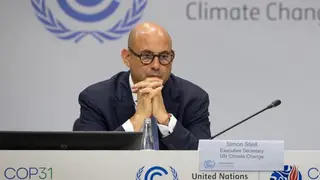
The 2026 UN Climate Change Conference in Antalya, Türkiye, concluded without a final climate agreement after nations failed to agree on fossil fuel phase-out commitments, carbon capture policies, and climate finance for developing countries. Despite support from over 130 nations for stronger fossil fuel transition language, opposition from major oil-producing states, including Saudi Arabia, blocked consensus. UN Secretary-General Antonio Guterres called the outcome disappointing, warning that current policies could lead to a 2.8°C rise in global temperatures.
The 2026 UN Climate Change Conference, COP31, concluded in Antalya, Türkiye, on November 22 without a final climate agreement after two weeks of negotiations and two additional days of talks failed to resolve key disputes. Over 130 nations backed stronger language on phasing out fossil fuels, but opposition from major oil-producing states—particularly Saudi Arabia, representing the League of Arab States—blocked consensus. The European Union, Panama, and the Marshall Islands criticized the absence of fossil fuel transition commitments, arguing it undermined prior agreements made at COP28 in Dubai, where nations pledged to transition away from fossil fuels in energy systems. Meanwhile, Pakistan urged continued dialogue, while Ghana, speaking for the African Group, highlighted insufficient progress on climate finance, loss and damage, and just transition mechanisms. The failure to agree on carbon capture and storage (CCS) policies and on tripling adaptation finance further weakened the outcome. According to the UNEP Emissions Gap Report 2026, current policies could lead to a 2.8°C rise in global temperatures, even if all current national commitments are met. The report underscores that emissions must fall 18% by 2030, 45% by 2035, and 69% by 2040 to stay on track for 1.5°C, requiring 320 billion tonnes of CO2 removal this century. Despite the lack of a formal pact, global clean energy investment is projected to reach $2.2 trillion in 2026—65% of total energy investment—though disparities persist, with advanced economies and China driving most growth. Nearly 100 countries support a 35% electrification target by 2035, though experts warn it could increase fossil fuel use if not paired with clean generation. The unresolved issues include how to balance technological solutions like CCS with fossil fuel reduction, how to deliver climate finance to vulnerable nations, and how to ensure that electrification advances do not inadvertently expand fossil fuel dependence.
The failure of COP31 to produce a binding climate agreement could undermine global momentum toward decarbonization, particularly in developing nations that rely on international support for adaptation and clean energy deployment. Countries most vulnerable to climate impacts—such as small island states and low-lying coastal nations—may face heightened risks due to delayed investment in resilience infrastructure, potentially increasing migration pressures and economic instability. The lack of a clear fossil fuel phase-out framework may also slow the transition in energy-intensive sectors, affecting long-term energy security and investment in renewables. Financial markets may respond with increased caution toward green projects in emerging economies, where uncertainty over climate finance could raise borrowing costs and deter private capital. This outcome echoes the 2015 Paris Agreement’s initial challenges, where weak commitments and enforcement mechanisms led to uneven implementation. However, unlike then, current investment trends show strong momentum in clean energy, suggesting a market-driven shift may persist even without formal agreements. Still, the absence of coordinated policy signals could delay innovation and infrastructure scaling. What may follow is increased regional or bilateral climate initiatives, with the EU and U.S. possibly advancing their own frameworks, while developing nations push for stronger accountability mechanisms in future COPs. Monitoring how clean energy investment evolves in non-OECD countries and whether new multilateral finance instruments emerge will be critical indicators of resilience in the global climate effort.