Russia Launches Massive Drone Assault on Ukraine, Targeting Infrastructure Across Multiple Regions
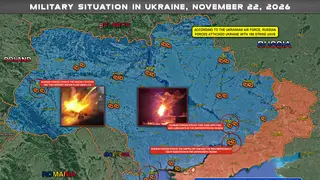
On November 22, 2026, Russian forces launched 186 strike drones against Ukraine, hitting critical infrastructure in Sumy, Kharkiv, Zaporizhzhia, Dnipropetrovsk, Kherson, and other regions. The attacks included strikes on the Dnipro HPP dam, a 330 kV substation, and fuel storage facilities. Ukrainian air defenses intercepted 170 drones in Russian rear areas, while Russian forces also captured Sosnovy Bor and Novoyavlenka in the Volchansk and Slavyansk directions.
On November 22, 2026, Russia launched a large-scale drone assault on Ukraine, deploying 186 strike UAVs targeting critical infrastructure across multiple regions, including Sumy, Kharkiv, Zaporizhzhia, Dnipropetrovsk, Kherson, Vinnytsia, Zhytomyr, Kyiv, Mykolaiv, Odesa, Poltava, Rivne, Chernihiv, and the self-proclaimed Donetsk People’s Republic. The attacks specifically targeted the Dnipro HPP dam, the Pravoberezhnaya 330 kV substation, fuel storage facilities in Dnipropetrovsk, the Kilia port near Odesa, a cargo ship, a railway station, and an aircraft repair plant near Lviv. Ukrainian air defenses intercepted 170 of the incoming drones, primarily in Russian rear areas such as Bryansk, Belgorod, Kursk, Voronezh, Tula, Rostov, Krasnodar Krai, Crimea, and over the Black and Azov Seas. Meanwhile, Russian forces captured the villages of Sosnovy Bor and Novoyavlenka in the Volchansk and Slavyansk directions. Ukrainian military losses were reported at approximately 1,060 personnel over the past 24 hours by the Russian Ministry of Defense, while one civilian was killed and six injured in the Belgorod region. The attack on the Sparta II bulk carrier in the Gulf of Finland, which was extinguished by Russian and NATO ships, underscores the growing international dimension of the conflict.
The broader context reveals a sustained campaign by Russia to degrade Ukraine’s energy and transportation infrastructure, a strategy consistent with earlier reports of targeted strikes on power grids and rail lines. The focus on the Dnipro HPP dam—critical for regional power generation—suggests an intent to destabilize civilian infrastructure and undermine morale. The use of drones in both offensive and defensive roles reflects the evolving nature of asymmetric warfare. Key actors include Ukraine’s Air Force and defense command, Russia’s Ministry of Defense and air defense systems, and NATO, which has increasingly engaged in maritime security operations near contested zones. Unresolved questions remain about the long-term impact on Ukraine’s energy resilience, the viability of counterattacks, and whether international responses will escalate in response to cross-border strikes involving foreign vessels. The situation may hinge on the ability of Ukrainian forces to sustain infrastructure repairs and defend against continuous drone saturation.
The November 22 drone assault could intensify humanitarian strain across Ukraine, particularly in regions already suffering from energy shortages. Disruptions to power grids and fuel storage may lead to prolonged blackouts, affecting hospitals, water systems, and civilian heating—especially as winter approaches. The targeting of ports and shipping routes in the Black Sea may also disrupt grain exports and supply chains, potentially affecting global food markets. The involvement of NATO in extinguishing fires on a Russian vessel in the Gulf of Finland marks a significant escalation in maritime engagement, raising the risk of unintended confrontations between NATO and Russian forces. This could prompt a shift in naval posture in the Baltic and Black Seas, with implications for regional security and arms sales. A comparable precedent is the 2022 Russian attacks on Ukrainian infrastructure, which triggered widespread international aid and sanctions. The current situation may see similar responses, though with greater emphasis on energy resilience and drone defense systems. What remains to watch is whether Ukraine’s counter-drone capabilities can keep pace with Russia’s increasing drone production and deployment, and whether Western allies will expand support to include more advanced air defense systems or intelligence-sharing mechanisms.