New Evidence Suggests a Hidden Planet May Exist Beyond Neptune
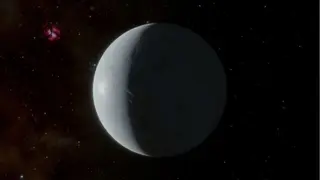
Astronomers have uncovered fresh data that strengthens the case for a massive, undiscovered planet beyond Neptune, often referred to as Planet X2. The findings are based on gravitational anomalies observed in the orbits of distant trans-Neptunian objects. These clues bring scientists closer to confirming the existence of a ninth planet in our solar system.
Astronomers have identified new gravitational anomalies in the orbits of distant trans-Neptunian objects, adding fresh weight to the hypothesis of a massive, unseen planet beyond Neptune—commonly referred to as Planet X2. These irregularities in orbital paths suggest the presence of a large, undiscovered planetary body whose gravity is influencing the motion of smaller, distant objects in the outer solar system. While no direct observation has yet confirmed the planet’s existence, the consistency of these anomalies across multiple objects strengthens the scientific case for its presence. The findings represent a significant development in the ongoing search for a ninth planet, a topic that has drawn sustained interest since the early 2010s when initial theoretical models first proposed such a body.
The idea of a hidden planet beyond Neptune has been discussed for decades, with earlier speculation dating back to the 19th century when discrepancies in Uranus’s orbit led to the discovery of Neptune. More recently, in 2016, researchers at Caltech proposed the existence of a massive planet—Planet Nine—based on similar orbital patterns. The current findings build upon that work, offering updated data that refine the predicted location and mass range of the hypothetical planet. The scientific community, particularly astrophysicists and planetary scientists, remains cautiously optimistic, as the evidence continues to accumulate. However, the planet has not yet been observed directly, and confirmation remains elusive.
The search is being led by teams at major research institutions, including Caltech and other observatories involved in deep-space surveys. These organizations seek to resolve one of the most enduring mysteries in solar system science. What remains unresolved is whether the anomalies are due to a single massive planet or could be explained by alternative models, such as a cluster of smaller bodies or observational bias. The next steps involve more detailed surveys of the outer solar system, potentially using next-generation telescopes, to either detect the planet or rule out its existence.
The discovery of a potential hidden planet could reshape public understanding of our solar system’s structure and history, reinforcing the idea that significant planetary bodies remain undiscovered even in our cosmic backyard. This may inspire renewed interest in space exploration and science education, particularly among younger audiences, and could influence funding priorities for deep-space observation projects. Institutions like NASA and international observatories may see increased support for missions targeting the outer solar system, potentially accelerating the development of advanced telescopes and data analysis tools. Historically, the search for Neptune in the 19th century demonstrated how gravitational anomalies could lead to the discovery of new planets, setting a precedent for today’s work. If confirmed, Planet X2 could follow a similar path, validating long-standing theoretical models. However, the absence of direct detection means the scientific community remains cautious, and public excitement may wane if no confirmation emerges in the near term. The broader impact may be felt in how space agencies frame their long-term missions, with the possibility of a "ninth planet" serving as a compelling narrative for public engagement. What to watch for is whether new observational data from upcoming telescopes, such as the Vera C. Rubin Observatory, will provide definitive evidence—or challenge the current hypothesis.