SpaceX Achieves 32-Hour Launch Turnaround from Single Pad
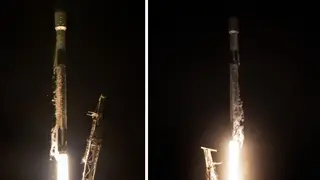
SpaceX set a new record by launching two Falcon 9 rockets from Vandenberg Space Force Base's SLC-4E pad just 32 hours apart. The first mission, USSF-317, launched on November 20, and the second, NROL-136, lifted off on November 22. The previous record of 45 hours was held by a launch from Cape Canaveral. The company's team achieved the milestone with several hours of margin, aiming for a 24-hour turnaround in the future.
SpaceX achieved a new milestone in launch efficiency by completing two Falcon 9 missions from Vandenberg Space Force Base’s SLC-4E pad just 32 hours and 3 minutes apart, breaking the prior record of 45 hours set at Cape Canaveral’s Pad 40. The first launch, USSF-317, occurred on November 20, 2026, at 8:20 p.m. PT, carrying a payload for the U.S. Space Force and marking the 11th flight of its first-stage booster. The second mission, NROL-136, launched on November 22 at 4:23 a.m. PT, serving the National Reconnaissance Office (NRO) and representing the 14th flight of its booster. Both missions successfully executed stage separation and landing—on a droneship for the first and on Landing Zone 4 at Vandenberg for the second—demonstrating rapid turnaround and reusability. This achievement builds on SpaceX’s ongoing efforts to increase launch cadence and reduce costs through rapid reuse of hardware, a strategy central to its long-term vision. The NRO’s proliferated satellite constellation, initiated with NROL-146 in May 2024, now includes 15 missions through 2026, with plans extending to 2029 to enhance intelligence collection, data speed, and system resilience. The U.S. Space Force has additional missions scheduled for November 24 and 28, further testing the limits of operational tempo. The team, led by VP Kiko Dontchev, expressed confidence in achieving a 24-hour turnaround in the near future, signaling a shift toward sustained, high-frequency launch operations.
This record-breaking turnaround could significantly impact national security and commercial space operations by enabling faster deployment of critical satellite constellations. For the U.S. Space Force and NRO, such speed enhances strategic responsiveness, reducing vulnerabilities from single-point failures and improving real-time intelligence access. The broader space industry may follow suit, with competitors like ULA and Rocket Lab potentially accelerating their own launch cadences to keep pace. The success of SpaceX’s rapid reuse model may also influence satellite design, pushing for smaller, more modular systems that can be launched frequently. A comparable precedent is the Cold War-era push for rapid ICBM deployment, where speed and reliability defined strategic advantage. However, sustained high-frequency launches raise questions about infrastructure strain, regulatory oversight, and long-term hardware reliability. What remains uncertain is whether this pace can be maintained over months or years without increased risk of failure. The next phase—achieving a 24-hour turnaround—will be a key test of operational maturity and could redefine what is possible in space logistics.