Roman Observatory Set for Falcon Heavy Liftoff from Kennedy Space Center
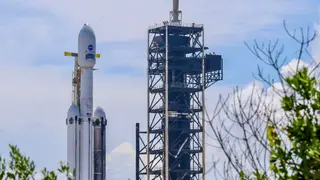
NASA's Nancy Grace Roman Space Telescope is scheduled to launch on a SpaceX Falcon Heavy rocket from Florida's Kennedy Space Center on August 30 at 7:26 a.m. EDT. The observatory will travel to Lagrange Point 2, about 1.6 million kilometers from Earth, to conduct wide-field surveys of the universe. Its mission includes studying dark matter and dark energy, as well as directly imaging exoplanets.
The telescope's destination, Lagrange Point 2, offers a stable vantage roughly 1.6 million kilometers from Earth, keeping the sun and planet aligned behind it for an unobstructed celestial view. Its survey capabilities are expected to generate thousands of daily images, enabling broad studies of dark matter, dark energy, and direct exoplanet imaging. At approximately the size of a tour bus and weighing as much as a Tyrannosaurus rex, the observatory represents a significant leap in survey capacity compared to its predecessors.
Launch weather remains the primary concern, with forecasters tracking offshore cumulus clouds that could produce showers or thunderstorms. Conditions are expected to improve for backup windows on Monday and Tuesday, reducing the likelihood of weather-related launch violations to roughly 30 percent. Mission managers confirmed a "go" during Saturday's prelaunch briefing, with liftoff targeted for 7:26 a.m. EDT from Kennedy Space Center's Launch Complex-39A.
This launch could reshape how astronomers approach fundamental questions about the universe's composition and the prevalence of Earth-like worlds. By enabling rapid, wide-field surveys, the observatory may accelerate discoveries in dark matter and dark energy research, potentially influencing future space science funding and educational priorities. Its exoplanet imaging capabilities could also inform public understanding of habitability beyond our solar system, though results will take time to materialize.