Roman Space Telescope Blasts Off to Probe Cosmic Mysteries
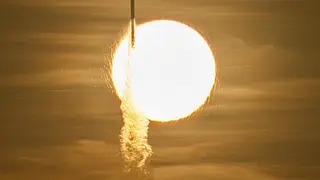
NASA's Nancy Grace Roman Space Telescope launched successfully on August 30, 2026, from Kennedy Space Center aboard a SpaceX Falcon Heavy rocket. The mission will study dark matter and dark energy, survey exoplanets, and map stars from the sun-Earth L2 Lagrange point. Engineers will calibrate its instruments over the coming weeks as it travels to its operational orbit.
The telescope lifted off from Kennedy Space Center's Launch Complex 39A at 7:26 A.M. EDT on August 30, 2026, aboard a Falcon Heavy rocket. It will settle at the sun-Earth L2 Lagrange point, roughly a million miles behind Earth, where gravitational forces balance, allowing constant communication and an unobstructed view of the cosmos. Over the coming weeks, engineers will calibrate and activate its instruments during transit.
Roman's five-year primary mission includes a vast sky survey—so large that a single image from its biggest survey would require over half a million 4K TVs to display fully. Its coronagraph instrument can detect exoplanets about 100 million times fainter than their host stars. The telescope will also investigate dark energy and dark matter, potentially testing whether the standard model of the universe holds.
This mission could reshape fundamental physics and astronomy, as its dark energy and dark matter findings may confirm or challenge the standard cosmological model. The exoplanet census could influence how humanity understands planetary habitability, potentially guiding future searches for life. Society may benefit from technological spin-offs and renewed public interest in space science, though the full societal impact depends on what the data ultimately reveals over the mission's five-year span.