Hubble reveals age differences among stars in ancient globular cluster
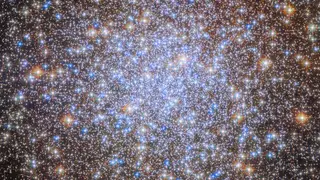
A new Hubble Space Telescope image of the globular cluster NGC 6723 shows a dense core of bright blue stars surrounded by older orange stars, indicating that stars within the cluster formed at different times. This challenges the long-held assumption that all stars in a globular cluster share the same age and composition. The cluster, located 27,000 light-years away, is one of the Milky Way's oldest structures.
EXPANDED:
The Chandelier Cluster's dual stellar populations emerged from Hubble observations conducted in 2013 and 2014, part of a broader survey examining 65 globular clusters. Astronomers identified two distinct epochs of star formation, with the second wave occurring roughly 634 million years after the first. The cluster's structure also reveals a sorting effect: massive stars migrate toward the dense core while lighter stars drift to the periphery.
Globular