Webb spots unusually mature galaxy cluster packed with dark matter
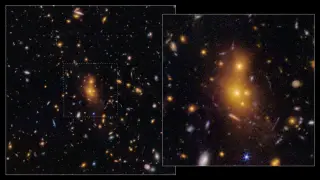
The James Webb Space Telescope has examined XLSSC 122, a galaxy cluster roughly 10.4 billion light-years away that appears far more developed than expected for its era. Researchers report that it holds an unusually dense concentration of matter and is the most distant cluster known to act as a strong gravitational lens. The work suggests some large cosmic structures formed faster than current models predict and hints at a new way to study dark matter through scattered starlight.
Researchers from IPAC at Caltech described three studies of XLSSC 122, presented in June 2026 at an American Astronomical Society meeting. The cluster sits about 10.4 billion light-years away and existed during "cosmic noon," an era when star birth peaked and galaxies often formed stars far faster than today.
Its alignment in front of more distant galaxies makes it the farthest known cluster producing strong lensing. That effect lets astronomers map mass, including unseen dark matter. The cluster's advanced structure and dense matter suggest some large cosmic systems assembled sooner than models anticipate.
This finding may influence astronomers, cosmologists, and observatories by sharpening models of early structure growth and dark matter. It could also affect science communication and public interest in space telescopes, as record-setting discoveries often draw attention to JWST and related research. Over time, improved dark matter mapping might inform education and future instrument priorities, though practical societal effects are likely indirect and gradual.