Roman Space Telescope's flawless launch marks new era for astronomy
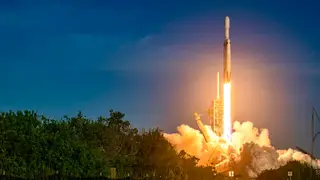
The Roman Space Telescope launched successfully on a Falcon Heavy rocket from Florida on August 30. Its Wide Field Instrument will capture vast cosmic views to study dark matter and dark energy, while the coronagraph will directly image exoplanets. The mission aims to address long-standing questions about the universe's expansion and the Hubble tension.
The telescope's two primary instruments serve distinct research purposes. The Wide Field Instrument will survey expansive regions of sky to capture transient cosmic events and probe the distribution of dark matter and dark energy. The Coronagraph Instrument will directly photograph exoplanets, potentially producing images comparable to Voyager's iconic "Pale Blue Dot" portrait of Earth.
Following liftoff, Roman began standard post-launch operations including outgassing, achieving power-positive status, and cooling to operational temperatures. It will spend roughly 90 days in commissioning while traveling approximately one million miles to the sun-Earth Lagrange Point 2, the same gravitationally stable location occupied by the James Webb Space Telescope.
The Roman Space Telescope could reshape fundamental understanding of cosmic expansion and the Hubble tension, potentially resolving contradictions that have puzzled astronomers for decades. Its wide-field surveys may accelerate discovery of transient phenomena, while direct exoplanet imaging could provide unprecedented views of distant worlds. The mission's success may inspire renewed public interest in space science and demonstrate the value of large-scale astronomical investment, though its full scientific payoff will require years of data collection and analysis.