Saturn's south pole reveals unexpected ten-sided atmospheric feature
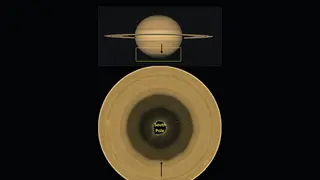
Astronomers have confirmed a decagon-shaped weather pattern near Saturn's south pole using Hubble images from 2023 to 2025. The feature, about 13,000 kilometers across, is smaller and moves differently than the known north polar hexagon. Its formation may be linked to a large storm, though the exact cause remains uncertain.
The decagon spans roughly 13,000 kilometers, slightly exceeding Earth's diameter. It was first spotted by amateur astronomers in 2024, then confirmed through Hubble observations covering 2023 to 2025. Unlike the north pole's hexagon, which has persisted for decades, this southern feature appears to rotate more in sync with the planet itself.
No spacecraft has visited Saturn since Cassini's mission ended in 2017, leaving a gap in direct observations. Researchers suspect the shape emerges from atmospheric waves interacting with a meandering jet stream, possibly triggered by a large storm. The pattern's longevity remains unknown, though the James Webb Space Telescope may offer further scrutiny.
This discovery could reshape how scientists understand planetary atmospheric dynamics, particularly the formation of polygonal weather patterns. It may influence future mission priorities, as researchers seek to explain how such features emerge and evolve. For the public, it reinforces that even well-studied planets like Saturn retain surprises, potentially sustaining interest in space exploration and funding for planetary science.