Human Brain Organoids Integrate with Mouse Neural Circuits
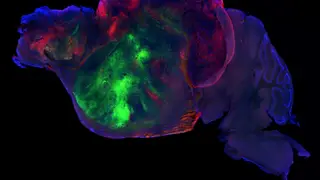
Scientists transplanted lab-grown human brain organoids into mice lacking certain brain regions, allowing the organoids to form functional neural circuits. This integration overcomes previous limitations of organoids, such as lack of blood supply and sensory input. The technique could enable modeling of neurodevelopmental diseases like autism and dementia.
The study’s key innovation was creating mice with a genetic deletion that removed the cerebral cortex and hippocampus, leaving roughly half the normal brain volume. This gave slow-growing human organoids space and time to mature without being outcompeted by faster-developing mouse neurons. Over months, each graft expanded from about 100,000 to four million neurons, with axons extending into the spinal cord. Imaging revealed coordinated activity within the graft, indicating functional communication. Notably, the organoids produced von Economo neurons—cells linked to social cognition in large-brained animals—which have never appeared in organoids grown in dishes, suggesting the living brain environment supports more advanced development.
This technique could reshape how researchers study neurodevelopmental disorders, offering a more realistic platform than static organoids for testing drugs or observing disease progression. However, it raises ethical questions about consciousness and animal welfare, as human neurons integrate into rodent brains. The approach may also complicate interpretations of neural activity, since distinguishing human from mouse signals is difficult. Ultimately, it could accelerate personalized medicine, but careful oversight will be needed to balance scientific promise with responsible use.