Radio waves from exoplanet Beta Pictoris b detected for the first time
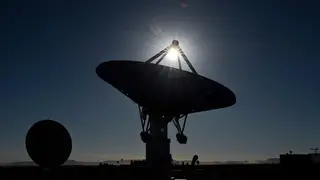
Astronomers using the MeerKAT radio telescope in South Africa have detected radio emissions coming directly from the exoplanet Beta Pictoris b. The signals are believed to be produced by powerful auroras, caused by charged particles from the host star interacting with the planet's upper atmosphere, rather than by any artificial source. This marks the first convincing direct detection of radio waves from a planet outside our solar system, opening a new window for studying exoplanetary magnetic fields and atmospheres.
The detection was made by a team led by Kevin Ortiz Ceballos of the Harvard and Smithsonian Center for Astrophysics, using the MeerKAT array in South Africa. Beta Pictoris b, located 64 light-years away, is a gas giant roughly ten times Jupiter's mass. The team confirmed the radio bursts originated from the planet rather than its host star by cross-referencing their positions with distant background quasars.
Previous exoplanet radio detections were tentative or indirect, according to Oxford astrophysicist Suzanne Aigrain. The signals are attributed to auroral activity—much stronger versions of phenomena seen on Earth and Saturn—produced when charged stellar particles interact with the planet's upper atmosphere. This opens a new observational pathway for studying exoplanetary magnetic fields and atmospheric dynamics.
This discovery could reshape how scientists study distant worlds, offering a new method for probing exoplanetary magnetic fields and atmospheric processes without relying on indirect techniques. It may also inform the search for habitable planets, since magnetic fields play a role in shielding atmospheres from stellar radiation. The finding could help refine the distinction between natural radio emissions and potential technosignatures, potentially sharpening the focus of future SETI efforts. Researchers and space agencies may prioritize radio observations of known exoplanets, while public interest in space science could grow as the line between natural and artificial cosmic signals becomes clearer.