NASA Tests Advanced Landing Guidance System on Drone
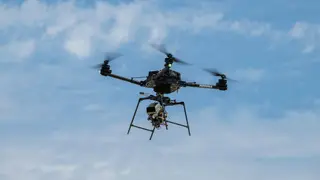
NASA tested its Safe and Precise Landing – Integrated Capabilities Evolution (SPLICE) system on an Alta-X drone, successfully completing simulated lunar descent and landing maneuvers. The technology is designed to enable precise landings on the Moon, Mars, and icy worlds in unknown or hard-to-reach areas.
The SPLICE experiment was mounted on an Alta-X drone and flown near NASA's Armstrong Flight Research Center in Edwards, California, on August 27, 2026. The test simulated lunar descent and landing maneuvers to validate the system's performance in a controlled environment.
Developed at NASA's Johnson Space Center in Houston, SPLICE combines specialized navigation, guidance, and processing technologies. These capabilities are intended to support safe, precise landings on the Moon, Mars, and icy worlds, particularly in challenging or scientifically valuable terrain that is difficult to reach.
This technology could enable future missions to land in previously inaccessible areas of the Moon, Mars, and icy moons, expanding scientific discovery. It may also influence commercial lunar landers and private space ventures, potentially reducing landing risks. Society could benefit from more ambitious exploration missions, though the immediate impact remains limited to the space industry and research community.