Japanese fossils reveal new armored dinosaur species with North American roots
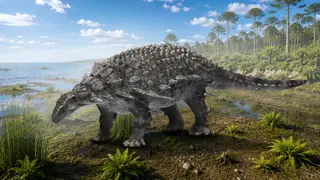
Fossils discovered in Japan over 30 years ago have been identified as a new species of nodosaurid, an armored dinosaur, making it only the third such find in Asia. CT scans of the 93- to 100-million-year-old remains show anatomical similarities to North American species, suggesting ancestors crossed the Bering Land Bridge. The study appears in the February 2027 issue of Cretaceous Research.
The specimen, unearthed on Hokkaido in 1995, includes cranial fragments, jaw elements, teeth, and bony armor plates. CT scans allowed researchers to reconstruct internal structures without damaging the fossil, revealing traits that distinguish it from other nodosaurids. Its age places it in the mid-Cretaceous, a period when sea levels and land connections differed markedly from today.
N. yezoensis joins only two other Asian nodosaurid species, underscoring how rare these dinosaurs are in the region. Its closest anatomical matches lie in North American forms, supporting a dispersal route across the Bering Land Bridge. This pattern mirrors other dinosaur migrations, suggesting repeated faunal exchanges between continents during the Cretaceous.
This discovery could reshape understanding of dinosaur biogeography, particularly how armored species dispersed across continents. For paleontologists, it may prompt reexamination of other Asian fossils previously misidentified or overlooked. Public interest in dinosaurs could also grow, potentially boosting museum attendance and science education. However, its broader societal impact remains modest, limited to academic and enthusiast circles, unless it influences future research funding or museum exhibits.