Solar Module Shipments Dip as Manufacturing Capacity Overshoots Demand
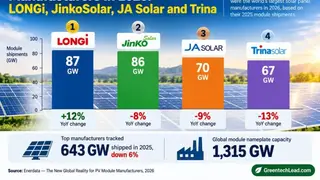
Global solar module shipments fell 6% to 643 GW in 2025 even as installations hit a record 664 GW, while nameplate manufacturing capacity jumped 27% to 1,315 GW, pushing aggregate utilization down to roughly 49%. LONGi led with an estimated 87 GW shipped, narrowly ahead of JinkoSolar at 86 GW, followed by JA Solar at 70 GW and Trina Solar at 67 GW. The oversupply is forcing manufacturers to compete on technology, profitability, and geographic diversification rather than sheer volume.
The industry's aggregate utilization rate collapsed to roughly half of nameplate capacity, as capacity expansion outpaced actual demand by a wide margin. This oversupply has pushed the competitive focus away from raw output toward operational efficiency and financial resilience, with leading firms showing divergent shipment trajectories—LONGi grew while JinkoSolar contracted.
Wood Mackenzie's broader assessment weighs factors like vertical integration, R&D, and supply-chain resilience, not just volume. Notably, non-Chinese manufacturers like Adani Solar, ELITE Solar, and Qcells secured top-ten positions, reflecting how trade barriers and domestic-content rules are reshaping the competitive landscape beyond sheer scale.
The persistent oversupply could drive down solar module prices, making renewable installations more affordable for households and utilities, potentially accelerating the energy transition. However, sustained low utilization may force factory closures or consolidation, affecting manufacturing jobs and regional supply chains. This dynamic could also shape future trade policies, as countries balance cheap imports against domestic industrial resilience, influencing where and how solar energy is produced globally.