Commercial Solar Modules Reach 25% Efficiency Milestone
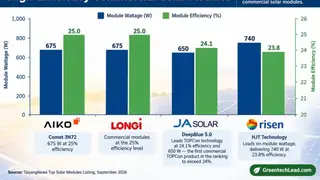
AIKO and LONGi have both commercialized solar modules achieving 25% efficiency, while JA Solar’s TOPCon product leads that technology at 24.1% and Risen Energy’s HJT module reaches 740 W at 23.8% efficiency. The TaiyangNews ranking of 38 high-efficiency modules shows back-contact technology at the frontier, with PERC modules capped at 21.7%. Modules exceeding 22.5% efficiency now represent 53% of tracked products, up from 16% in January 2024, as efficiency becomes a key differentiator for project economics.
The TaiyangNews ranking tracks 38 commercial modules from 31 manufacturers, with back-contact technology now holding the efficiency frontier. AIKO's Comet 3N72 delivers 675 W at 25 percent, while its G4 Infinite Ultra platform reportedly reaches 25.6 percent in mass production. LONGi's HIBC architecture achieved 25 percent commercially, though its certified 28.13 percent cell efficiency and 26.4 percent research module suggest considerable headroom remains as manufacturing matures.
The technology shift is reshaping the market landscape. PERC modules now cap at 21.7 percent, while N-type TOPCon, HJT, and back-contact designs dominate the upper tiers. The proportion of tracked products exceeding 22.5 percent efficiency jumped from 16 percent in January 2024 to 53 percent by mid-2026, reflecting rapid industrial adoption of advanced architectures.
This efficiency milestone could meaningfully affect solar project economics for developers, homeowners, and utilities. Higher-efficiency modules generate more power per square meter, potentially reducing land requirements and balance-of-system costs for large installations while expanding viable rooftop options in space-constrained urban settings. However, the practical benefit may vary by application, as cost per watt, degradation rates, and temperature performance remain equally important factors. Consumers may see a widening gap between premium high-efficiency products and lower-cost alternatives, potentially influencing purchasing decisions and accelerating the retirement of older PERC manufacturing capacity.