White dwarf's persistent shock wave defies known stellar mechanisms
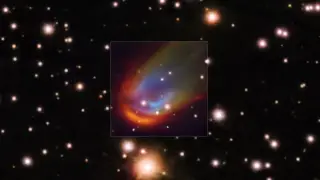
Observations with ESO's Very Large Telescope revealed a long-lived shock wave around the white dwarf RXJ0528+2838, which has no detectable disk. The outflow powering this structure cannot be explained by current models, suggesting an unknown energy source such as magnetic fields. The finding challenges existing ideas about how dead stars interact with their surroundings.
RXJ0528+2838 resides roughly 730 light-years away, paired with a Sun-like companion. The bow shock appears as a glowing arc, with hydrogen, nitrogen, and oxygen emitting in distinct colors. Unlike typical binary white dwarfs, this system shows no accretion disk, which normally feeds outflows.
The shock wave has endured for at least a millennium, far longer than expected. Astronomers used the MUSE instrument on ESO's Very Large Telescope, following initial detections from Spain's Isaac Newton Telescope. The study, published in Nature Astronomy, suggests magnetic fields or an unidentified "mystery engine" could drive the persistent outflow, challenging standard models of stellar remnants.
This discovery may force astrophysicists to revise models of how dead stars interact with their environments, potentially affecting predictions about binary evolution and galactic chemical enrichment. For the public, it underscores that even "dead" objects can harbor unexpected activity, which could inspire renewed interest in space science. Funding agencies may also reconsider priorities for studying magnetic fields in stellar remnants, though direct societal impact remains limited to advancing fundamental knowledge.