Phononic Crystal Adapter Could Soften Rocket Launch Shocks
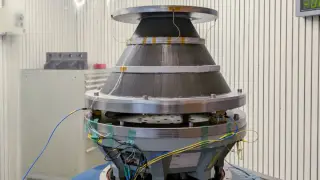
Researchers in Switzerland from Empa and Beyond Gravity built a prototype payload adapter that uses phononic crystals, metamaterials designed to control mechanical waves. The adapter redirects strong vertical launch vibrations into rotational motion, moving aluminum rings and reducing the energy that reaches a satellite. The approach aims to protect delicate spacecraft components without relying on heavy rubber cushions or motorized dampers.
The adapter sits between a rocket and its satellite, a normally rigid mount that can pass launch vibrations upward. The Swiss prototype instead uses phononic crystals—engineered materials that shape mechanical waves much as photonic crystals shape light—to divert vertical shocks into spinning motion.
That motion is absorbed by movable aluminum rings, lowering the energy reaching onboard systems. The team, from Empa and Beyond Gravity, has filed a patent and completed simulations and bench tests, though the concept remains at NASA's Technology Readiness Level 4–5.
If it matures, this adapter could affect satellite builders, launch providers, and the scientists who rely on orbital instruments. By potentially reducing vibration damage and structural reinforcement needs, it may lower launch costs or free capacity for more delicate payloads. That could broaden access to space-based research and commercial services, though adoption depends on further testing and cost competitiveness.