Fossil Limb Bones Show Australopithecus Mixed Tree Climbing and Walking
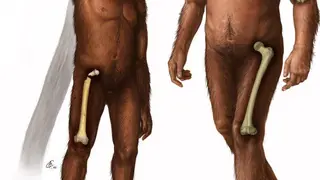
CT scans of fossil limb bones from Australopithecus and early Homo, dating roughly 1.5 million to 3.7 million years ago, reveal differences in how these ancestors used their arms and legs. Australopithecus appears to have spent substantial time in trees while also using its legs in a human-like bipedal manner. Early Homo showed a more ground-oriented pattern, marking a major shift in locomotion, according to the study in Science Advances.
Researchers led by USC’s Keck School of Medicine examined seven fossil individuals from Australopithecus and early Homo, spanning about 1.5 million to 3.7 million years. Using CT scans, they assessed bone shaft thickness and resistance to bending and twisting, then compared arm, thigh, and shin strength within each skeleton.
Australopithecus showed ape-like upper-limb strength alongside human-like thigh-to-shin proportions, implying tree movement remained important while legs supported upright walking. Early Homo, dated about 1.8 million to 2.3 million years ago, had stronger thighs relative to arms, a pattern closer to modern humans and ground travel. The work appeared in Science Advances.
This finding may reshape how museums, educators, and science communicators present human origins, offering a more nuanced image of Australopithecus as both tree climber and biped. Students and general audiences could encounter updated exhibits or lessons that emphasize locomotion as a gradual, mixed strategy. Paleoanthropologists may use the bone-strength approach to revisit other fossils, though conclusions will depend on further specimens and independent replication.