Enceladus naturally concentrates ocean chemicals in space ice, aiding life-search efforts
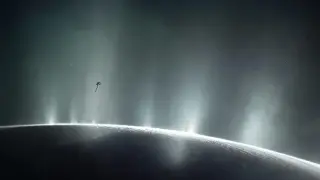
Researchers have discovered that water droplets from Enceladus's hidden ocean undergo natural chemical separation and concentration as they freeze and fragment during their journey into space. This process explains peculiar variations in ice grain composition detected by the Cassini spacecraft during its mission from 2004 to 2017. The finding could significantly enhance future missions' ability to detect organic compounds and biosignatures in the moon's ejected material.
Saturn's moon Enceladus possesses a subsurface ocean hidden beneath its icy crust, accessible to study through water and ice particles naturally ejected into space near the south pole. The Cassini spacecraft collected compositional data on these particles between 2004 and 2017, revealing unexpected variety in salt concentrations across individual ice grains despite their common ocean origin.
Laboratory experiments revealed that freezing speed fundamentally alters how dissolved salts distribute within water droplets. Slower freezing processes allow chemical separation, concentrating different mineral compounds in distinct regions. When these partially frozen droplets subsequently fragment during their journey to space, they produce numerous smaller ice grains with markedly different chemical signatures, explaining Cassini's observations.
This discovery could enhance astrobiology missions by clarifying how to interpret chemical signatures in extraterrestrial ice samples. Future spacecraft analyzing Enceladus materials may more effectively distinguish between geochemical processes and potential biosignatures, since the natural concentration mechanism now provides a clearer baseline for comparison. This understanding could streamline the search for life indicators in ocean worlds throughout the solar system and beyond.