China Achieves Booster Recovery Milestone with Long March 10B, Accelerating Lunar Program Timeline
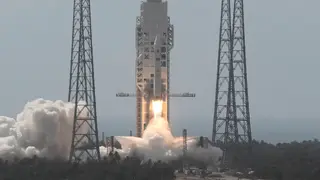
China successfully completed the first orbital flight of the Long March 10B in July 2026, with the rocket's first stage being caught in a recovery net aboard a ship in the South China Sea, making it the second country to achieve controlled booster recovery. The Long March 10 is designed to execute China's goal of landing two astronauts on the lunar surface before 2030 through a two-launch lunar-orbit rendezvous architecture. By conducting routine orbital missions with the rocket's core hardware years before crewed lunar flights begin, China is building flight-proven infrastructure that mirrors its strategy of integrating national programs with commercial satellite launch contracts.
China's Long March 10B represents a deliberate engineering strategy that differs markedly from prior lunar programs. Rather than building a dedicated Moon rocket and reserving it exclusively for crewed missions, Chinese planners have structured the program to generate commercial satellite launch contracts using the same core hardware. This approach allows the rocket's components to accumulate flight hours and operational data years before astronauts depend on them for lunar transport.
The two-launch lunar architecture chosen by China requires less total payload capacity than Apollo's single-launch approach, enabling a more compact rocket design. By the time the full three-core Long March 10 lifts off in 2027 for its first crewed mission, its single-core derivative will have completed multiple orbital missions, including booster recovery operations that test the vehicle's most critical systems.
This development could strengthen China's position in space exploration while potentially influencing how other nations approach heavy-lift rocket programs. The integration of commercial and government missions may accelerate technological maturation and reduce long-term program costs. However, the approach's success depends on reliable booster recovery systems and sustained funding. International observers may reassess timelines for lunar exploration achievements and competition in space capabilities, though the ultimate impact on broader geopolitical dynamics remains uncertain.