Offshore Wind Economics Remain Competitive Despite Multibillion-Dollar Project Costs
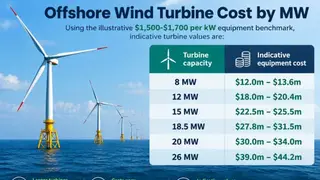
Offshore wind turbines range from approximately $12 million to over $40 million depending on capacity and specifications, with a typical 15 MW unit valued at $22.5 million to $25.5 million, though complete wind farm projects extend costs into several billion dollars when including foundations, cables, installation, and grid connections. IRENA data shows global offshore wind achieved a weighted-average cost of electricity of $78 per megawatt-hour in 2025, remaining economically competitive despite higher initial capital investment than onshore wind or solar alternatives. The complete cost structure varies significantly by geography, with factors such as water depth, distance from shore, seabed conditions, and local labor costs creating substantial differences between markets.
Individual offshore wind turbines represent a substantial capital commitment, with equipment costs typically spanning $12 million to $40 million depending on their power rating. The most common modern units generate 15 megawatts of electricity, placing them in the $22.5–25.5 million range. However, a single turbine constitutes only a fraction of total project expenses; developers must also invest in underwater foundations, subsea cabling systems, offshore electrical substations, specialized installation vessels, and grid connection infrastructure that collectively drive complete offshore wind farms into the multibillion-dollar range.
Geographic variation significantly influences project economics. Water depth, distance from coastlines, seabed composition, local labor availability, and existing port infrastructure all create substantial cost differences across regions. U.S. fixed-bottom offshore wind projects have demonstrated significantly higher capital requirements than global averages, with estimates reaching $5.4 billion per gigawatt, while floating-platform systems push costs even higher due to mooring systems and anchoring technology.
Offshore wind's competitive cost of $78 per megawatt-hour may influence energy investment patterns and policy decisions favoring renewable generation infrastructure. Prospective developers, utilities, and governments could view these economics as justifying substantial upfront spending on marine renewable projects. However, the financial burden remains significant enough that project viability may depend on regional market conditions, financing availability, and policy support mechanisms, potentially affecting which nations and regions accelerate their renewable energy transitions.