Telecom Economics Shift as Network Efficiency and Traffic Scale Drive Down Per-Gigabyte Costs
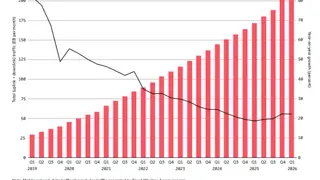
Global mobile data traffic surpassed 220 exabytes monthly in mid-2026, representing a sevenfold increase from 2019 levels, while operators have not proportionally increased spending, resulting in declining cost-per-gigabyte economics. Reliance Jio's operations illustrate this scale advantage, carrying 241 exabytes annually across increasingly efficient 5G infrastructure where fixed costs like spectrum and fiber routes distribute across exponentially larger data volumes. Improvements in spectral efficiency, network automation, and energy consumption are reinforcing the economics favoring operators with largest traffic volumes.
The telecommunications industry is experiencing a fundamental shift in its cost structure as operators manage vastly larger data volumes without proportional increases in spending. Fixed expenses—including spectrum licenses, infrastructure equipment, and fiber installations—now distribute across seven times the data traffic compared to 2019, creating economies of scale that benefit carriers most. Simultaneously, technological improvements in 5G deployment, network automation systems, and energy efficiency are amplifying this advantage, allowing operators to serve growing demand while reducing their per-unit costs.
India's largest carriers illustrate this trend concretely. One operator achieved a 92 percent reduction in energy consumption per unit of traffic over a decade, while another now carries over 240 exabytes annually across increasingly utilized infrastructure. These improvements suggest that network capacity is becoming less constrained by cost and more dependent on operational efficiency and subscriber adoption rates.
These dynamics could reshape competition in telecom markets by favoring operators with largest customer bases and traffic volumes, potentially accelerating industry consolidation. Consumers may benefit from continued price pressure on data services, though competitive outcomes depend on market structure. The trend could also incentivize infrastructure investment in data centers and AI services, as carriers seek to monetize their increasingly efficient networks beyond traditional mobile services. Developing markets with high data consumption growth may see particular economic benefits.