NASA Developing Advanced Humanoid Robots to Support Rather Than Replace Lunar Astronauts
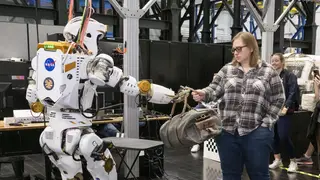
NASA's Dexterous Robotics Team is engineering next-generation bipedal robots designed to enhance astronaut safety and sustainability during missions to the moon and Mars, rather than eliminate human space exploration. The robots must overcome extraordinary engineering challenges unique to space environments, including microgravity, abrasive lunar dust, and intense solar radiation that complicate both hardware and software design. NASA has been advancing bipedal robot technology for over 15 years through projects like Valkyrie and Robonaut 2, and now focuses on platforms like iMETRO to test systems that astronauts will depend on for tasks ranging from lunar base maintenance to scientific research.
NASA's Dexterous Robotics Team operates within a larger robotics division focused on the intersection of programming and mechanical engineering. The team's work builds on foundations laid over the past 15 years, including earlier platforms that demonstrated the feasibility of bipedal systems in space contexts. The Johnson Space Center in Houston serves as the primary development hub, where researchers tackle the unique obstacles presented by extraterrestrial environments—particularly microgravity conditions, corrosive dust particles on lunar surfaces, and harsh radiation exposure that degrades both electronic and mechanical components far more rapidly than on Earth.
The team's testing facility, iMETRO, represents a comprehensive approach to validation before deployment. It simulates multiple space environments including terrain comparable to the lunar surface, spacecraft interiors, and operational equipment astronauts will encounter. This infrastructure allows engineers to anticipate failure modes and refine robotic systems iteratively, significantly reducing mission risk and preventing costly in-flight malfunctions during actual lunar or Mars expeditions.
The development of capable robotic assistants could reshape space exploration economics and safety protocols across multiple sectors. Private space companies and government agencies might benefit from reduced personnel risk during hazardous maintenance tasks, potentially lowering mission costs and expanding exploration timelines. However, the successful integration of autonomous systems into crew operations depends on establishing reliable human-robot coordination protocols and addressing public perception about automation in high-stakes environments. These technological advances may influence broader discussions about robotics' societal role beyond aerospace applications.