Distributed Memory Architecture Proves Essential for Commercial Humanoid Robot Reliability
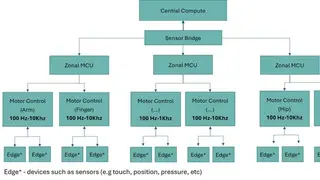
Humanoid robots scaling toward commercial deployment in factories and warehouses require multi-tier distributed memory architectures supporting centralized AI processing alongside embedded microcontrollers in limbs and actuators. Non-volatile memory distributed across the system enables high-endurance logging, functional safety verification, and resilient time-sensitive networking critical for autonomous operation. With production shipments projected to grow from 15,000 units in 2025 to over 6 million annually by 2035, optimizing memory technologies across diverse subsystems becomes increasingly important for reliability and performance.
Commercial humanoid robot deployments face architectural challenges distinct from previous automation systems. These platforms require simultaneous optimization across multiple memory technologies—high-bandwidth options for centralized AI processing, deterministic low-latency solutions for distributed motor controllers, and durable non-volatile storage for reliability tracking across diverse operating conditions.
The scale of projected growth intensifies memory engineering demands. Current systems already generate telemetry at sampling rates exceeding 10 kilohertz to support predictive maintenance and safety verification, creating endurance pressures on conventional storage technologies that existing solutions may struggle to sustain across millions of deployed units.
The reliability architecture described could significantly influence humanoid robot adoption timelines across manufacturing and logistics sectors. Organizations deploying these systems may experience reduced downtime and maintenance costs if memory architectures prove robust at scale, potentially accelerating workforce augmentation in facilities-based operations. Conversely, memory failures could trigger costly delays or safety incidents, affecting investment confidence in the technology. Memory specialists and semiconductor manufacturers stand to shape competitive dynamics by solving these edge-computing challenges effectively.