Europe Positioned to Develop Indigenous Battery Supply Chain by 2030
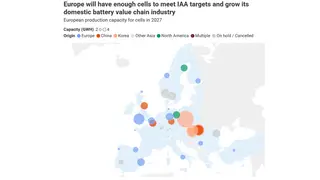
Analysis shows that European battery cell production will meet regional demand for electric vehicles covered under the Industrial Accelerator Act by 2030 if local content requirements are implemented for battery components. The primary bottleneck in Europe's battery supply chain remains cathode active materials, where China currently dominates global production. Establishing European domestic production capacity through mandatory local content rules could increase regional battery demand by 34% and secure critical manufacturing jobs during the automotive sector's transition.
Europe's battery manufacturing sector faces a critical juncture as policymakers negotiate terms for the Industrial Accelerator Act. Analysis from Transport and Environment indicates that if European producers receive guaranteed demand through mandatory local content rules, they can produce sufficient battery cells to supply the continent's electric vehicle market by 2030. The analysis directly challenges automotive industry arguments that such requirements are unrealistic.
The fundamental challenge lies in midstream production—specifically cathode active materials and their precursors. China currently controls the majority of global capacity in this segment, creating a significant vulnerability in Europe's supply chain. Establishing domestic production facilities for these components requires long-term purchasing agreements that cell manufacturers currently lack, creating a circular dependency that local content mandates could help resolve.
The outcomes of these policy negotiations could reshape Europe's manufacturing landscape and global battery competition. Workers in automotive and chemical sectors may see employment shifts as production facilities develop, while consumers could experience supply chain effects on EV pricing and availability. European strategic autonomy in critical technology sectors could be enhanced or diminished depending on whether local content rules are adopted. Chinese battery manufacturers and their European competitors would face substantially different competitive dynamics under either regulatory scenario.