Long-Term Bond Yields Surge to Five-Year Highs as Fixed-Income Repricing Accelerates
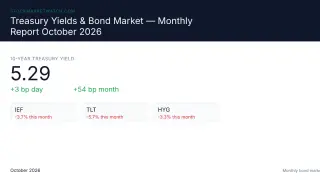
Treasury yields have climbed significantly in October 2026, with the 10-year yield reaching 5.29% and the 20-year yield hitting 5.68%, driven by persistent inflation and increased government debt supply. The shift reflects a transition from expectations of lower rates to a hiking-bias environment, fueled by artificial intelligence infrastructure demand keeping price pressures elevated. Despite the bond market weakness, equity markets remain relatively resilient with the S&P 500 down only 1.24% for the month.
The bond market repricing reflects a fundamental shift in economic expectations. Throughout 2026, Treasury yields have climbed substantially across all maturities, with the steepest increases occurring at the intermediate end of the curve. The 2-year yield has risen over 140 basis points year-to-date, outpacing longer-dated securities, while the policy rate remains anchored at 3.75-4.00%.
This yield environment is being shaped by competing forces: persistent inflationary pressures tied to artificial intelligence infrastructure buildout and elevated government borrowing needs. Despite this bond market stress, equity valuations have held relatively firm, suggesting investors maintain confidence in economic fundamentals. The disconnect between fixed-income weakness and stock resilience underscores market uncertainty about whether current rate levels represent sustainable equilibrium or a temporary dislocation.
The sustained elevation in borrowing costs could affect households' ability to refinance mortgages and access consumer credit, potentially slowing spending. Corporations may face higher capital expenditure constraints, which could influence business investment decisions. Pension funds and insurance companies holding longer-duration bonds may experience portfolio pressure. Conversely, savers and money market investors could benefit from improved yields on short-term instruments. The outcome may depend on whether inflation moderates, allowing yields to stabilize, or persists, requiring further rate adjustments.