Putin rejects ceasefire proposal on strikes as Russia escalates aerial bombardment of Ukraine
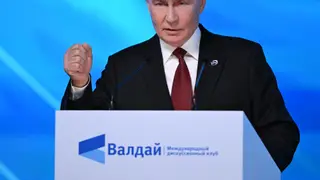
Russian President Vladimir Putin dismissed a potential agreement to halt long-range strikes on both sides, dismissing the proposal as absurd while Moscow intensifies its aerial campaign against Ukrainian targets. Putin cited that Russian oil refineries have suffered losses equivalent to 1 percent of GDP from Ukrainian strikes but claimed Russia is now responding in kind with attacks on Ukrainian infrastructure and supply chains. A Russian drone struck a school in Kyiv on the day of Putin's remarks, continuing the relentless aerial assault that has kept the capital under constant threat heading into winter.
Putin's dismissal of the ceasefire proposal came after diplomatic discussions in late September between U.S. and Ukrainian leaders regarding a potential mutual halt to strikes on energy infrastructure. The Russian president characterized such an agreement as nonsensical, emphasizing that Ukrainian attacks on Russian oil refineries have inflicted significant economic damage. Russia has responded by intensifying its own aerial campaign, deliberately targeting Ukrainian industrial capacity and transportation networks as winter approaches.
The threat of nuclear escalation featured prominently in Putin's remarks, with Russia issuing formal warnings to NATO about potential nuclear deployment if the Baltic region became a flashpoint. Putin framed the conflict as potentially resolvable through negotiations that would establish Ukraine's neutrality, while simultaneously threatening catastrophic consequences for any direct military confrontation involving Russian territory.
The hardened positions outlined by Putin could significantly impact prospects for near-term diplomatic resolution, potentially prolonging the conflict through winter months when civilian vulnerability increases. Ukraine and its Western allies may face difficult calculations regarding military strategy and negotiation tactics. Russia's explicit nuclear rhetoric could influence NATO decision-making regarding support levels and involvement, while civilian populations in both countries remain exposed to intensifying aerial campaigns and potential escalation spirals that neither side appears positioned to de-escalate.