Observatory Detects Prolonged X-Ray Emissions Following Neutron Star Merger
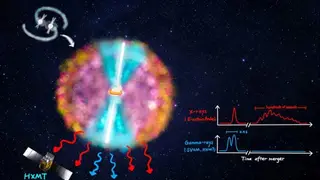
The Einstein Probe space observatory captured previously undetectable soft X-ray emissions lasting nearly ten minutes after a short gamma-ray burst from colliding neutron stars, revealing a hidden phase of stellar merger dynamics. Traditional X-ray telescopes typically require gamma-ray alerts to locate bursts, missing the earliest soft X-ray signals that occur in the initial moments of the explosion. This observation demonstrates how wide-field monitoring can expose extended emission periods that conventional instruments would overlook due to their lower-energy nature.
Neutron star collisions represent some of the universe's most violent events, generating both gravitational waves and electromagnetic radiation across multiple energy bands. When two neutron stars orbit and eventually merge, the resulting explosion releases tremendous energy, yet much of this activity occurs at wavelengths that traditional telescopes cannot detect quickly enough. The Einstein Probe observatory's key advantage lies in its continuous wide-field monitoring capability, allowing it to observe soft X-ray emissions simultaneously with their occurrence rather than waiting for alerts from other instruments.
This particular detection revealed that the energetic phase following a merger extends far longer than previously documented through conventional methods. The soft X-ray emissions persisted for nearly ten minutes after the initial bright gamma-ray flash, suggesting that merger remnants undergo complex physical processes during an extended period. The international follow-up observations confirmed the burst's distance and ruled out alternative explanations, establishing that the prolonged X-ray activity originated directly from the merger remnant rather than from surrounding material heated by the explosion's shock wave.
This discovery may influence how astronomers design future space missions and prioritize observational strategies for studying extreme cosmic events. Understanding the complete lifecycle of neutron star mergers could enhance predictions about gravitational wave detection and electromagnetic counterparts, potentially improving early-warning systems for ground-based observatories. The findings may also refine theoretical models of compact object physics and matter behavior under extreme conditions, with implications for fundamental physics research and our comprehension of element formation in the universe.