AT&T, T-Mobile and Verizon Form Joint Venture as Starlink Pulls Ahead in Satellite Connectivity Race
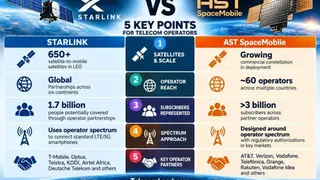
Major U.S. carriers announced a joint satellite connectivity initiative on October 1, 2026, as competition intensifies between Starlink and AST SpaceMobile for direct-to-device satellite coverage. Starlink currently leads with 59 mobile-operator partnerships compared to AST SpaceMobile's 28, though actual adoption remains limited with less than 1 percent of U.S. smartphone users accessing satellite connections. Telecom operators are increasingly treating satellite connectivity as a complement to terrestrial 4G and 5G networks rather than a replacement, particularly for coverage gaps in underserved areas.
The satellite-to-device connectivity market has expanded significantly over the past year, with global connections rising nearly a quarter between mid-2025 and early 2026. Starlink's competitive advantage rests on its substantial orbital fleet and established relationships with dozens of telecommunications firms worldwide, whereas AST SpaceMobile emphasizes a model centered on leveraging carrier-owned spectrum and broadband services. The technological trajectory matters considerably: Starlink's planned second-generation system could deliver substantially higher data throughput and enable full 5G support, potentially reshaping how operators view satellite infrastructure integration.
Current real-world performance reveals the technology remains preliminary. Testing of T-Mobile's satellite messaging service showed message delivery success rates around 60 percent with variable latency, while less than half a percent of U.S. smartphone users currently access D2D satellite connections. This suggests satellite technology functions primarily as a targeted solution for geographic coverage gaps rather than mainstream mobile service replacement.
Satellite connectivity expansion could affect rural and remote populations by improving emergency communication and basic mobile access in underserved regions. Telecom operators may reduce infrastructure investment costs in hard-to-reach areas. However, widespread adoption depends on performance improvements, spectrum availability, and regulatory coordination across markets. Network reliability, device compatibility, and pricing models will likely determine whether satellite services become integral to mobile networks or remain niche offerings for specific use cases.