Bennu's Dual Origins Challenge Understanding of Early Solar System Formation
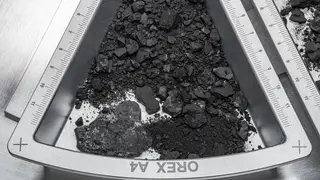
Analysis of pristine samples from asteroid Bennu returned by the OSIRIS-REx mission reveals an unexpected puzzle: the asteroid contains isotopic signatures suggesting material from both the inner and outer solar system, regions typically separated during planetary formation. Researchers at ETH Zurich and Lawrence Livermore National Laboratory hypothesize that Jupiter's gravitational influence may have mixed materials from different regions of the protoplanetary disk into a single asteroid. This discovery challenges conventional models of how the early solar system organized and distributed different types of planetary building blocks.
The OSIRIS-REx mission successfully retrieved pristine asteroid material that had never undergone atmospheric heating, enabling scientists to study the solar system's earliest composition. Researchers analyzed isotopic ratios—slight variations in atomic structure of elements like iron, titanium, and chromium—which serve as chemical fingerprints indicating where materials formed. Different regions of the protoplanetary disk contained distinct isotopic signatures based on temperature and distance from the young Sun.
The formation timeline proved crucial to understanding Bennu's origins. Dating techniques using radioactive decay indicated the asteroid assembled roughly 2 million years after the solar system's first solid materials appeared. This rapid assembly in the inner solar system contradicted the expected composition of carbonaceous asteroids, which typically form more slowly in the outer, colder regions. The unusual iron isotope signature suggested material transport between distant solar system zones.
This discovery could reshape planetary formation models that scientists use to understand how Earth and other worlds gathered their components. Educational curricula teaching solar system development may require updating as models become more refined. The findings may also influence how researchers interpret data from future asteroid sample return missions, potentially affecting priorities for upcoming space exploration missions. Understanding these planetary assembly mechanisms has indirect implications for how scientists assess planetary habitability in exoplanetary systems.