Communications Satellite Completes Orbital Repositioning Maneuver
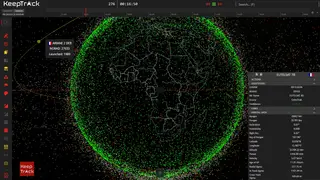
The EUTELSAT 7B satellite has executed a precise orbital adjustment, settling into a new position at 16.0°E longitude following a detected maneuver on September 17, 2026. The repositioning involved a total velocity change of 0.58 m/s across multiple orbital parameters, including adjustments to the satellite's altitude and inclination. Automated tracking systems indicate the satellite has stabilized near the ELEKTRO-L 3 meteorological satellite, suggesting successful completion of this station-keeping operation.
The EUTELSAT 7B satellite, a communications platform deployed by European operator EUTSA in 2013, executed a controlled orbital adjustment in mid-September 2026. The maneuver involved multiple directional velocity changes totaling less than one meter per second, with the satellite's altitude raised by approximately 8 kilometers while its orbital inclination shifted marginally. The operation positioned the satellite at 16.0°E longitude, placing it in close proximity to the Russian meteorological satellite ELEKTRO-L 3.
This type of station-keeping maneuver represents routine orbital maintenance for geostationary communications satellites, which must periodically correct their positions to counteract gravitational perturbations and solar radiation pressure. The precision of such adjustments—measured in fractions of a meter per second—reflects decades of operational experience in maintaining satellite constellations that support global telecommunications infrastructure.
Routine satellite repositioning operations like this one may have minimal direct public visibility but support critical infrastructure that billions of people depend upon daily. Communications satellites enable telecommunications, broadcasting, and data services across Europe and Africa. While individual maneuvers are standard maintenance, the collective health of satellite constellations affects service reliability and pricing for consumers and businesses relying on these networks. Space-domain awareness tracking systems that document such events contribute to safer orbital operations by reducing collision risks.