Thermally Modified Polymer Fibers Create Dual-Function Sensors for Extreme Conditions
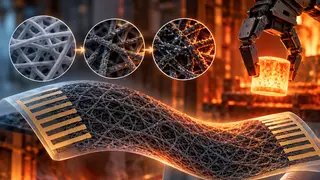
Scientists developed heat-treated polyacrylonitrile fiber matrices that function as independent temperature and pressure sensors, capable of operating across extreme thermal ranges up to 300°C. The flexible sensing platform demonstrated accurate measurement across a wide pressure range from 0 to 480 kPa under normal conditions. Performance limitations emerged when both temperature and pressure loads were applied simultaneously above certain thresholds, indicating structural constraints in the material.
Heat treatment of polyacrylonitrile fibers has yielded a sensing material capable of independent operation in two measurement modes. The resulting fiber matrices can withstand temperatures reaching 300°C while maintaining functionality—a significant advantage for industrial applications requiring thermal resilience. Each sensor function operates independently, allowing users to deploy the same material platform for either temperature or pressure monitoring without hardware modifications.
The technology's versatility extends across substantial pressure ranges under standard operating conditions, though simultaneous thermal and mechanical stress reveals material limitations. When both environmental factors exceed certain combined thresholds, structural degradation compromises measurement accuracy, suggesting that future refinements may need to address composite material stability under complex loading scenarios.
Dual-function sensors capable of extreme-temperature operation could benefit aerospace, automotive, and industrial manufacturing sectors where equipment monitoring occurs in harsh environments. By consolidating multiple sensing functions into a single flexible material, manufacturing costs and installation complexity might decrease. However, the current performance constraints under combined stress loads suggest practical deployment would require careful selection of application environments, potentially limiting near-term commercial viability until material science advances resolve these structural vulnerabilities.