Neutrino Behavior May Determine Massive Star Fate Between Supernova and Black Hole
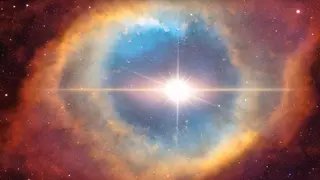
University of Copenhagen researchers developed simulations showing that neutrino flavor conversion—the switching between different types of nearly massless particles—could influence whether collapsing massive stars explode as supernovae or collapse silently into black holes. Since different neutrino flavors interact differently with matter inside collapsing stars, their transformations may affect energy transfer during the critical moments before potential explosion. The study tested this theory on 195 simulated collapsing stars and suggests that accounting for neutrino flavor conversion is crucial for understanding stellar outcomes.
When massive stars reach the end of their lives, they face two possible fates: a violent explosion that scatters material across space, or a silent collapse into a black hole. Researchers have struggled to understand what determines which outcome occurs. A new computational study suggests that nearly imperceptible particles called neutrinos, which barely interact with ordinary matter, may play a decisive role through their ability to transform between different types during stellar collapse.
The Copenhagen team ran computer simulations of 195 dying stars with masses ranging from 9 to 120 times the Sun's mass. By comparing models that accounted for neutrino flavor conversion against those that ignored it, they discovered that some stars in the 16-to-30 solar-mass range switched from explosive to failed outcomes when the effect was included. This suggests accounting for neutrino behavior is essential for accurately predicting how massive stars end their lives.
Understanding stellar death mechanisms could refine how astronomers interpret observations of supernovae and black hole formation across the universe. If neutrino flavor conversion proves relevant in real stars, it may reshape theoretical models used to study extreme astrophysics and could influence predictions about which collapsing stars produce visible explosions versus silent collapses. This knowledge might eventually improve understanding of how stellar explosions distribute heavy elements that seed new planetary systems.